
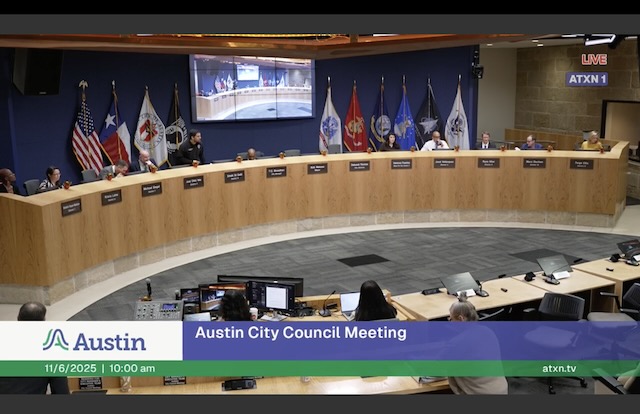
I am going to begin this week with something I imagine most readers don’t expect. That is a discussion of etiquette; specifically the eating habits of the Austin City Council during their meetings.
I decided to speak out on this topic after seeing a few people on social media calling for the City to stop paying to feed Council Members during Council meetings. These calls of course came in the wake of the trouncing of Prop Q. I respectfully disagree with these citizens and want to go on record in favor of City-paid meals – during official Council meetings – for the Mayor, Council Members, and staff whose job duties require them to be at the meetings. I also want to acknowledge that I have eaten quite a few meals of that type myself.
I want to be very clear here that I am not talking about the type of meals that City Manager T.C. Broadnax and Council Member Ryan Alter were charging to the City, as exposed by the Austin American-Statesman. The philosophy Broadnax and Alter were operating on was that they were working during their lunch so the City should pay for it. That’s not what I’m talking about. And, I also want to go on record, that it never occurred to me to charge that type of lunch to the City even though I worked during lunch many times. Nor do I think it ever occurred to any of my colleagues during that ancient era of less exalted Council Members. (Broadnax and Alter both repaid the City after the American-Statesman brought their practice to light.)
But, to me, providing food at Council meetings is different. Council meetings often last 12 hours or more, although not as often now that Kirk Watson is running the meetings — and I mean that as a compliment to the Mayor and as a favorable comparison to his predecessor. If the Mayor and Council Members had to recess the meeting to go out to eat that would mean even longer meetings and it would leave many citizens having to wait even longer to speak. (And I just don’t think it’s realistic to ask each Council Member to bring their own lunch.) Can’t we provide them a meal or two during their meetings, whether we like them or not?
Plus, Council Members going out to eat in the middle of meetings would almost certainly lead to lobbyists and activists besieging them during their meals, or trying to join them, or trying to pay for the meal. Do we really want that? By the way, I think it is still the policy that lobbyists can’t go behind the dais during meetings. I am proud to say that I personally got that policy instituted when I was on the Council; and I believe it is still in place. Now, there is even someone guarding the entrance.
I know some people will disagree with me on meal policy, but I plead with you that stopping City-paid meals during Council meetings is not the high ground on which to stage a battle; and it would lead to unintended consequences, some of which I just described.
At the same time I have to say that Council Members shouldn’t push things over the edge by bringing their food out onto the dais and eating it there. Please, either wait until the Council takes a break or just announce that you’re going to be off the dais for a few minutes to eat and will monitor the meeting on the video feed. It’s not that hard.
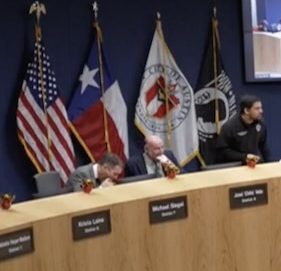
To be clear, I’m not encouraging Council Members to hide the fact that they’re getting a free meal from the taxpayers. I’m just saying that, to me, eating on the dais is bad manners and really tacky to boot. Plus, someone could easily snap a photo of you while you’re eating up there. Or, since the meetings are live streamed, someone could just take a screenshot from their desk at home (see below). They wouldn’t even have to catch it live. They could go back and find it on the video. That will show you being doubly ill mannered, because you’re eating on the dais during a public meeting, and eating on TV. It’s a particularly bad approach if thousands of voters just made clear that they think the Council is not properly handling tax dollars.
So, please, if not for yourself, then for Councils of the future, don’t bring your food on the dais.
Does the rejection of Prop Q really require budget “cuts?”
Moving on to more substantive matters, local media is awash with stories about massive “cuts” being made to the City budget, in the wake of Austin voters overwhelmingly rejecting Prop Q. KVUE went so far as to report “they are taking an axe to the budget.”
All these stories miss a fundamental governing and budgeting principle. These are not actually “cuts” to the City budget. Most of the outlets now publishing this cascade of stories reported back in July that the City Manager proposed a “balanced” budget. That budget featured a 3.5% property tax, the maximum allowed under state law without going to voters. The Mayor and City Council (except for Marc Duchen) decided to seek around $100 million more in property taxes, an additional five cents per $100 valuation.

Given that this additional $100 million plus required voter approval, that meant that the additional funds did not become part of the budget unless approved by voters. This made voters the final authority on whether the items proposed by Council would become part of the budget. The voters said no.
Perhaps it is too fine a point, but the process taking place now is not cutting the budget, because the items proposed by Council in Prop Q could only become part of the budget if voters approved them. That’s because when one proposes an expenditure and that proposed spending is turned down by those with final budgetary authority, that is not a cut. It is just a refusal to add something to the budget.
For a somewhat old fashioned example, if a kid asks for a raise in his or her allowance and the parents say no, that is not a cut to the kid’s allowance; regardless of how the kid might characterize it.
If a kid asks for a raise in his or her allowance and the parents say no, that is not a cut to the kid’s allowance.
Staff in the City Financial Services Office apparently share this viewpoint because the words “cut” and “cuts” do not appear in the office’s post-election memo titled “Fiscal year 2025-2026 Revised Budget Recommendation.” It is apparently from this document that media outlets talking about “cuts” are getting data. Instead staff uses the word “Reverse” to identify expenditures that the Council added through amendments to the City Manager’s Proposed budget; and that staff is now recommending to eliminate.
The “reversal” or “cut” that is getting the most media attention is $6.2 million that would have gone to Austin/Travis County Emergency Medical Services (EMS). There seems little doubt that EMS could put an additional $6 million to good use. But, if there is a crisis requiring that sort of addition, on top of what the City Manager proposes, the Council must bear some responsibility for allowing the agency to get in that sort of condition. That is especially true for the Members who have been in office for longer than one term. They should have been on top of this all along. (The Austin Independent submitted two questions seeking clarification on the exact EMS line items making up the $6.2 million, but the Communications office said they were not able to reply by press time. We also asked, again, for the full and final wording of all amendments that the Council added for Prop Q — a request originally made on September 30. We still have not been provided that either.)
In a sort of odd way, perhaps Council Members actually were focused on EMS funding in previous budgets. Broadnax’s proposed budget included $148.2 million for EMS, a three percent increase over last year’s $143.4 million. That’s keeping up with inflation. That amount is also a 14% increase from two years ago, the FY 2023-24 budget.
The EMS budget for fiscal year 2021-22, five years ago, was $102 million. So it has increased 45% since then.
Also, when Broadnax presented his proposed budget he said: “Balancing the budget with a shortfall in revenue while investing in key areas was made possible by a close and critical look at all spending, making reductions, realizing savings where appropriate and in a way that does not impact important services.” So Broadnax did not believe that his budget damaged “important services” like, presumably, EMS.
In any governmental budget process there will be worthy services and endeavors that don’t get funded to the level that ideally they should. That is especially the case when the governing body is trying to “put affordability first,” as our Mayor and Council have long maintained they are trying to do. For those in positions of responsibility who have to make such decisions it is extremely difficult and sometimes heart breaking.
So, if the Council wants to increase EMS funding or add any of the other items they intended with Prop Q, they have the authority to do so. They would just have to make tough calls and actually cut items from the original Broadnax budget. Some Council Members are evidently now busy drafting amendments to do so. That process will play out over the next few days. A Council budget work session is scheduled for Tuesday November 18, with the voting session scheduled for Thursday November 20. (The City website does not list any additional budget meetings, but the process could presumably be recessed and the Council reconvene the next day, if they do not finish on Thursday. Or they could schedule meetings for the following week.)
Before leaving this section let’s take a quick look at two other items.
First, according to the staff recommendations memo, one department gets more money under the new staff recommendation than in the original Broadnax recommendation. That is an additional $3.6 million for the Homelessness Strategy Office.
Also, as reported in the Austin Chronicle the activist group Equity Austin wants to reopen the police contract approved by Council last year. This is almost certainly what Mayor Kirk Watson was referring to in his Prop Q election night statement when he said, “This is not the time to engage in or relitigate significant, drawn out, divisive policy fights in the budget.” It will be interesting, to say the least, to see if anyone on the Council adopts the Equity Action approach; and how Watson responds if that were to happen.
Can Anybody Here Play This Game?
Everything I wrote in the section immediately above assumes that Council and City management will actually convene the budget meetings they have scheduled. That’s not how last week proceeded.
The Council was scheduled to begin their post-election budget discussions on Thursday November 13. On Wednesday, however, attorneys Bill Aleshire and Rick Fine sent a letter to the City warning that the official posting for the November 13 meeting featured “a significant violation of the Texas Open Meetings Act (TOMA).” As explained in a press release from the two, “the posted notice for the November 13, 2025 City Council meeting fails to comply with the legal requirement of TOMA to include a link to the proposed budget and an updated taxpayer impact statement.”
A press release announcing the Fine and Aleshire letter went out at 11:40 am on Wednesday November 12. By 4:52 pm that afternoon City staff was circulating a letter announcing that the next day’s meeting had been canceled.
A spokesperson for the City maintained, “The City Attorney’s Office consulted with outside legal experts prior to posting the agenda and believes it meets all legal requirements. However, our goal with the budget is to restore trust in the City, so we are willing to take additional steps to achieve that goal.” Let’s unpack that statement just a little bit.
If the City is trying to “restore trust” after a failed election, why not just be transparent and provide as much information as possible to interested citizens? Why hire “outside legal experts” to apparently advise the City that they don’t need to include a link to the proposed budget and an updated taxpayer impact statement in the Council backup? It’s odd, to say the least, especially since, within hours, City powers that be collapsed, canceled the scheduled meeting, and included the left out information in the backup for the rescheduled meeting. They then characterized their moves as an attempt to “restore trust.” What?
Also, as someone who was once involved in a lot of governing discussions, it is disappointing that apparently no one thought to ask beforehand: “Is there anybody out there who might sue us over this? Anybody who has successfully sued us before?”
Siegel questions voters’ knowledge
In the Austin Chronicle’s election wrap-up they quoted rookie Council Member Mike Siegel saying, “I don’t think the voters appreciate how deep the cuts are going to have to be.” Siegel was an early leader in pursuing a tax rate election i.e. Prop Q.
Well, we already discussed whether “cuts” is the accurate word to use in this situation. So, here’s let’s just note that it is always perilous for an elected official to criticize the voters. For instance if Siegel is correct that voters didn’t realize what they were doing when they voted on Prop Q then it’s entirely possible that District 7 voters didn’t realize what they were doing when they elected him.
Sorry to leave out Democrats’ in my Prop Q wrap-up
A few readers pointed out that my Prop Q wrap up story failed to note that the state Democratic Party was a big loser in the Prop Q campaign. That is accurate although my story was about the coalition that defeated Prop Q. Nonetheless I think the readers are correct that the story would have been more complete if it included a mention of the Texas Democratic Party’s role. So let’s briefly discuss that here.
Well, on the same night Prop Q went down Democrats in Virginia, New Jersey, New York City and Seattle won with varying messages focused on affordability. In Texas, however, the Texas Democratic Party and the State Democratic Executive Committee decided to get involved in a local (Austin) tax rate election, just as a nonpartisan anti-tax increase prairie fire was sweeping through the local electorate.
One way the state Democratic organs got involved was through two mailers distributed widely across Austin. The return address on those mailers read, “State Democratic Executive Committee” and the disclaimer reported, “Paid for by the Texas Democratic Party.” Additionally, the newly anointed Democratic Congressman for virtually all of Austin, Greg Casar, was a prominent Prop Q supporter.
The Travis County Democratic Party was also deeply involved in the election, including being listed as an endorser on both of the aforementioned mailers and on the campaign website.
Does anyone have any thoughts on why Democrats have not won a statewide race in Texas since 1994?
_____________________________
Folks: You won’t find local reporting like this anywhere else in Austin. Please consider subscribing and/or donating to help us keep it going. It will help us, for example, to expand our readership base and to pay for important public information requests To subscribe or donate, click here.
To receive notification when the Austin Independent posts stories, to subscribe, or to write to the editor please send us an email under Contact on the home page,or click here.
The Austin Independent, a publication of The Austin Independent, LLC
All Rights Reserved