
Here at the Austin Independent we just don’t have the capacity to provide comprehensive zoning coverage, although I wish we did. I wish someone, anyone in town, did. I periodically, however, cover individual zoning cases which I think stand alone in their importance and/or reflect broader policies and dynamics going on in our community. Our coverage of the Acacia Cliffs case comes to mind.
In this instance, the property in question is a relatively small tract and the outcome won’t have a major, or any, impact on people except the property owners and the residents of the neighborhood. But, that is true of many zoning cases, and people charged with deciding zoning cases are supposed to consider the impact their decisions have on people’s lives.
At the same time this tract carries special significance because of the neighborhood’s history. The neighborhood is tied to the Jim Crow era and the 1928 Plan which designated East Austin as the place for Black and Mexican American people to live. The Blackland Neighborhood was originally a predominately Swedish neighborhood, but evolved to become predominately Black after the 1928 plan.
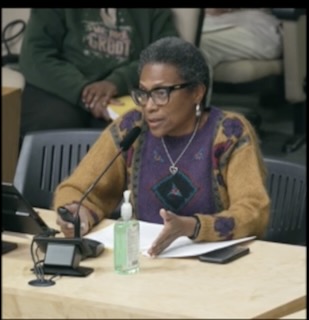
Additionally some important figures in the history of East Austin live, and lived, in the neighborhood. Some have family connections to important Civil Rights leaders in Austin history. For instance the president of the neighborhood association is Marva Overton (screenshot at top). She is a niece of Volma Overton, a legendary leader of the Civil Rights Movement in Austin.
Also a resident of the Blackland Neighborhood, and of E. 22nd Street, is former Council Member Ora Houston (2015-2018). Houston was a longtime important figure in East Austin even before being elected to the Council. Ms. Houston’s parents were historic figures before her. Her mother, Thelma Mitchell Elliott, was the first Black female to receive a Master’s Degree in Social Work from the University of Texas. Ms. Houston’s father, Ora Herman Elliott, was the first Black man appointed by the Governor to the Board of Colleges and Universities. He also helped save the Law School at Texas Southern University and worked to insure funding for Austin Community College.
YIMBYism in Austin
So that history, and more, contributes to this being a significant zoning case. Also, this case — really any zoning case — exemplifies how the Planning Commission handles its business and particularly the way it treats neighborhoods. (Members of the Planning Commission are appointed by individual Council Members or the Mayor.) Additionally, relevant to this case in particular, the Planning Commission is packed with what is known as YIMBYs (Yes in My Backyard). YIMBYism is a nationwide movement that favors high density virtually everywhere and specifically the scaling back of regulations that provide(d) some protections for single family neighborhoods and the investments that residents made to acquire their homes.
In recent years the YIMBY movement has won policy battles all over the country, including historic changes in Austin. Those include the HOME ordinance, which changed zoning rules to where three units are now allowed on every single family zoned lot in the city. The movement was also instrumental in the approval of DB90s (Density Bonus, 90 feet) that has led to approval of multiple 90-foot buildings that will soon tower over many neighborhoods. In fact Acacia Cliffs was a DB90 case.
Although members of the YIMBY movement are overwhelmingly white, including in Austin, they have repeatedly framed their movement as intended to make it possible for Black people and Mexican American people to find housing, especially in neighborhoods without large Black populations. They often frame this in a rather harsh manner.
For instance here is a missive from the YIMBYist Hyde Parker newsletter during the 2022 Council runoff between Linda Guerrero and Zo Qadri. “The city is fighting an uphill battle against powerful interests who find the status quo convenient and are terrified of opening up more of the city to people who might not look like, earn like, or think like they do.” This is an almost perfect encapsulation of YIMBY rhetoric. In this instance it was aimed at Guerrero who is a strong supporter of neighborhoods; and at her supporters.
Ironically, if that is the right word, this racially charged rhetoric was hurled during a runoff race where a Mexican American woman with a significant history of community service in Austin faced off against an inexperienced newcomer whose main campaign theme was that he would be the first Muslim on the Council — but who enthusiastically toed the YIMBY line. These two were advanced to the runoff in a District where almost two-thirds of the registered voters are white.
Also, Guerrero is the daughter of the legendary Roy Guerrero, the late longtime leader and barrier breaker in the Austin Parks and Recreation Department for whom Roy G. Guerrero Park in East Austin is named. None of this mattered, however, and Qadri sailed to victory.
I made the above diversion because I felt that I needed to provide an example of what I mean about YIMBY ideology and rhetoric. With that done, let’s return to the E. 22nd Street case.
One factor in that case (and many others) is that many Black people like living in single family homes, just as people of other races do. And, many Black people who do live in single family homes want to protect their homes and neighborhoods as much as people of other races. This has been a dynamic during virtually every major YIMBY effort in Austin, although it didn’t faze them. So let’s take a look at this case and see how these dynamics play out here.
The Site
The zoning case is at 2108 and 2110 E. 22nd Street. East 22nd is the next street south of Manor Road near a popular cluster of restaurants and bars. The specific lots are part of the swanky Este restaurant property, but do not currently have construction on them. One serves as what the property owner’s representative calls “informal parking” and the other hosts a garden. The entire site was formerly the location of the East Side Cafe and the garden provided some of the food served in the restaurant. The owners of Este now want to change the zoning from Single Family to Neighborhood Commercial, and then build a restaurant with some portion of the garden remaining as a feature of the restaurant. The neighborhood association is opposed.
Trip to the Site
So one recent Saturday afternoon Adela Mancías (my wife and editor) and I drove to the site. Over the years Adela and I have driven to the site of many zoning cases, particularly when I was on the City Council (1996-2005). I believe that it is important to visit a site and see the circumstances in person when preparing to vote on, or write about, a zoning case. That is true even if I am already familiar with the area.
Adela’s observations have often helped me on these excursions. For instance, immediately after arriving at this site we both observed the large number of cars parked in front of houses and the almost constant stream of cars looking for a parking place along both E. 22nd and E 21st Streets. Adela commented that it would be difficult for a household with two cars. That was, she continued, because the houses have single driveways so people would have to put one car behind the other in the driveway or join with the other drivers looking for street parking.
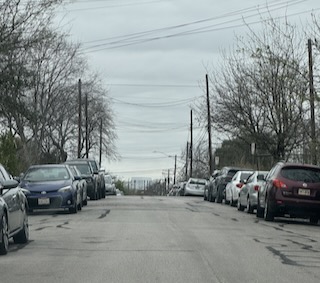
Parked cars line E. 22nd Street near Este Restaurant – photo by Daryl Slusher
The neighborhood itself is fairly heavily gentrified with roughly 60% remaining single family homes and much of the rest newer construction, some with multiple units per lot.
A Tale of Two Gardens
The case went to the Planning Commission on January 27 and is scheduled for City Council on March 12. The Planning Commission hearing began with very short comments from City staff who recommended approval of the proposed zoning change. At least one comment from Jonathan Tomko of the Planning Department seemed to bring into question how well informed staff is on the case as he said, “The subject tract is currently a community garden at the northwest corner of East 22nd and Coleto Street.”
That statement is inaccurate in at least two ways. The garden is on only one of the tracts. And, it is not a “community garden,” but a privately owned garden on private property. There is a community garden peripherally related to the case. It is about two blocks to the west on the property of the Blackland Community Development Corporation (BCDC). The developer has proposed that the gardener for Este provide around $10,000 in “onsite improvements” or other in kind services on the BCDC garden as a “community benefit” for the neighborhood. This would be for the first year the new project is open.
No one raised any objection to Tomko’s inaccurate statement. The gardens, however, later became a focus of Commission members — mainly the one behind the restaurant.
Tomko also reported, accurately, that “there are three single family homes to the south across E. 22nd Street and a single family home to the west of the subject property.
Representative for the Developer/Property Owner
Next up was Drew Raffaele, the representative for the property owners and a member of the Drenner Group. Without saying so directly he corrected Tomko on the current use of the property: “The property today is utilized as a garden, as well as some informal parking for the garden and for the restaurant to the north.”
Raffaele continued, “The purpose for our rezoning is for the development of a small restaurant space, primarily focused on breakfast and lunch, surrounding the garden, with some associated office space.” He said the building would be two stories, with the office space on the second floor. Raffaele added that current plans are for the restaurant to be open from 7 am to 3 pm with parking “managed onsite.” (There are no minimum parking requirements because the City Council eliminated them in 2023. Este opened in 2022 and relies on valet parking although anyone who doesn’t want to do valet can try to find a place in the neighborhood.)
Raffaele then elaborated on the garden, saying it “has been sort of a key element and feature to the design of this proposed project.” He added that the property owners “know that it’s been a part of the neighborhood for many, many years.” So, he continued, “we decided to retain it as part of this development and incorporate it.”
Public Speakers
Next the Commission heard from members of the public, in this case residents of the neighborhood. First up was Blackland Neighborhood Association President Marva Overton. She listed a number of objections to the proposed zoning changes.
Number one was “the encroachment of commercial building into the neighborhood.” Overton explained that the neighborhood plan supports commercial development along Manor Road. This proposal, however, would allow commercial development to “seep into the interior (of the neighborhood)” and “could potentially set a precedent for similar types of requests in the City.”
Overton next emphasized that “parking and traffic” are “a huge issue already in the neighborhood.” She added that a place to serve breakfast and lunch “will compound that problem.” She pointed out that the developer would “only be adding eight (parking) spaces.” Overton then explained that the owners are requesting “an exception” for “private dining” after their regular hours. This further complicates the issue, she said.
Overton summarized the parking and traffic situation, “So we’re talking about having traffic in the neighborhood throughout the whole day from 7 AM, or earlier from staff, all the way until after Este closes. So that’s a big issue.” (Property owner representative Raffaele later explained during his “rebuttal” that the private dining sort of activity is important to making such a business successful. That is probably true, but also leads back to whether encroaching on a single family neighborhood is the appropriate place to have such businesses.)
Next Overton addressed the garden. She explained, “The garden is one thing from the beginning that they (the property owners and their representatives) have been saying is a community benefit. Our position is that garden is nice to look at, but it has not benefitted Blackland in any substantial way.” She added, “there has never been any communication to the neighborhood around the utilization of that garden anyway.”
Ora Houston followed Overton. Houston began by saying she lives on E. 22nd Street. “I have lived there since in the 1950s when my parents built that house.” She continued that if the Commission voted yes they would be violating their “own mission statement.” She continued, “Your mission is to follow the City’s Neighborhood Plans, including in Blackland.”
Houston then listed some elements of the Blackland Neighborhood Plan, including:
- “limit commercial encroachment into residential areas;
- ensure all land development code amendments align with equity goals;” and
- “maintain the areas of historic and diverse character.”
Second, continued Houston, “rezoning would publicly and loudly show that the City fights for Austin’s monied class, exemplified by the property owner, his developers, and the University of Texas (which in earlier years began moving offices into the neighborhood). It will also show that the city fights against neighborhoods, and voters.”
Houston then discussed how the neighborhood evolved out of the 1928 city Master Plan, which she described as an action taken by “powerful, segregationist, white Austinites.” She added that the neighborhood plan “proves that later generations of Austinites tried to protect Blackland and the African American Cultural Heritage District.”
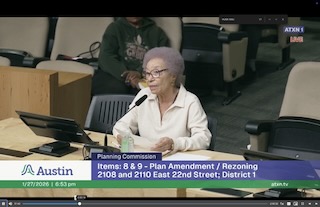
Houston then added, “All Austinites should be terrified, because, if you think you can destroy a protected space like Blackland, then you can destroy all Austin residential neighborhoods.”
The former Council Member continued that a yes vote would show that the Planning Commission has “no shame because this is not something that a neighborhood is supposed to look like,” that is:
- “With a commercial entity that directly fronts a residential neighborhood.
- Where we have children and elderly people going to the playground.”
Houston added, “You just don’t understand how crowded that street is already, with Este.”
“You just don’t understand how crowded that street is already, with Este.”
Ora Houston, Blackland resident and former city Council Member
Several other neighborhood residents spoke against the zoning change, including one woman who said she has lived in the neighborhood for “only 30 years.” She commented on the inability, or serious obstacles, to having people visit her home because of the parking problems.
Questions from Commissioners – Garden, Garden, Garden
Next came a round of questions from Planning Commissioners. These concentrated on the garden and to a lesser extent on parking. On parking, however, the main discussion was whether the parking could be made into paid parking. No conclusion was reached.
An exception to those lines of questioning came from Commissioner Danielle Skidmore. Skidmore, who often sides with the YIMBY point of view, asked a series of questions aimed at determining the nature and scale of the “encroachment into the existing residential area in the form of this restaurant.”
Another important question came from Commissioner Brian Brodosian who asked Raffaele: “Are you aware currently if the valet service for Este or Bar Toti (a “neighborhood bistro” immediately next door to Este) uses any of the street parking spaces for valet?”
“No, I’m not aware of that,” Raffaele quickly replied.
Brodosian then asked Raffaele if he could find out.
“Definitely, I’ll look into that,” replied Raffaele.
The Austin Independent reached out to Raffaele by email and asked if he had looked into the situation yet and, if so, what he found out. We did not hear back by press time. Now it remains to be seen whether a Council Member, or the Mayor, will ask about what seems like an important topic.
Skidmore and Brodosian both asked important questions, but most of the questioning and discussion by Planning Commissioners focused on the garden(s). For instance a search of the transcript on the City website shows that the word “garden” was said 74 times during the discussion of this zoning case.
This resulted in Marva Overton having to return to the microphone to answer several questions about the garden, the one behind the restaurant that is part of the zoning case. Among other attempts at explaining her point of view, Overton said, “I accept that this (the garden) is getting put forth as, like, ‘the thing.’ (But), “the issue is what they want to develop in a residential area. . . wanting an office, wanting an additional restaurant.” She added, “The parking is ridiculous.”
“I accept that this (the garden) is getting put forth as, like, ‘the thing.’ (But), “the issue is what they want to develop in a residential area. . .”
Marva Overton, president of blackland neighborhood association
In another answer, Overton said she attended meetings with the property owners who “kind of jumped on that,” i.e. the garden, “but nothing was ever put forth to say, ‘how can we work together to address this parking issue that you already have.” She added, “and that will be worse with another restaurant.”
Overton also referred back to the East Side Cafe and said, “There was a marked difference between when that restaurant was there and when Este opened.”
The Commission Votes
Next it was time for the Commissioners to vote on their recommendation to Council. There was no back and forth. Instead Commissioner Felicity Maxwell moved approval. Speaking about her motion she very briefly, almost perfunctorily, explained, “Obviouisly there is a change of use here, but I think there is also a net benefit in terms of continuing to allow our corridors to be vibrant.” She notably didn’t mention anything about allowing neighborhoods to remain vibrant.
Maxwell, by the way, is a proud YIMBY and a board member of AURA, perhaps Austin’s leading YIMBY group. She was appointed by Council Member Ryan Alter.

It is reflective of the atmosphere at City Hall that Maxwell didn’t bother to even address any of the comments brought up by neighborhood residents. It is also interesting that Maxwell chose to ignore the concerns of this particular neighborhood; given the long string of YIMBY rhetoric about how their ideology will help Black people and how anyone who opposes or questions their efforts is continuing the legacy of racism. That just didn’t come up in any discussion by the Planning Commissioners. Nor did any Planning Commissioner mention the neighborhood plan.
Soon the roll was called and the zoning changed passed nine to one. Danielle Skidmore was the only no vote. Skidmore explained that she did not believe another restaurant on the property would provide any “community benefit.” She added that the case left her “deeply uneasy about moving forward” with the restaurant being located “on a block that is otherwise housing.”
On Civil Rights Legacy
In closing I want to note that I don’t think the Commission or the Council should vote a certain way just because longtime residents of East Austin, with a legacy in the Civil Rights Movement, say they should. I do think, however, that members of the Commission and Council should take folks seriously and consider what people have to say. They should do that with all citizens, but it’s even worse when they ignore and dismiss people with the type of respected legacy that I describe. The phrase callous disregard comes to mind.
But, I am not accusing the Planning Commissioners of discriminating against the residents of Blackland. On the contrary, based on my observations, they treat all neighborhood groups like this.
Correction: This story originally stated that Ora Houston was the first Black woman to serve as an Austin City Council Member. That honor actually belongs to Sheryl Cole. The Austin Independent apologizes for the error and also will correct it in the next issue.
______________________
Folks: As we’ve mentioned before local, independent journalism is very poorly funded. Please consider subscribing or donating to the Austin Independent. It will help us, for example, to expand our readership base and to pay for important public information requests. To subscribe or donate, click here.
To receive notification when the Austin Independent posts stories, to subscribe, or to write to the editor please send us an email under Contact on the home page,or click here.
The Austin Independent, a publication of The Austin Independent, LLC
All Rights Reserved