
“Miracles appear in the strangest of places. . .”
Willie Nelson, Yesterday’s Wine
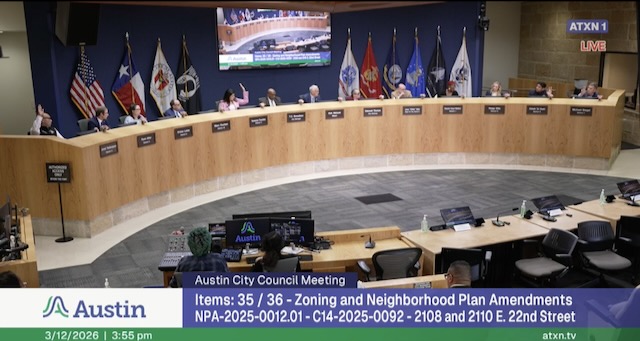
There was an apparent miracle at City Hall on March 12. A City Council majority voted down two zoning cases. This isn’t something that happens every Thursday, or really anytime nowadays, at Austin City Hall. According to information from the City of Austin Open Data Portal this was the first time since at least 2022 (and probably much longer) that a Council majority has rejected a proposed zoning case, except for historic zoning cases.
The term rubber stamp comes to mind.
The first of the two to go down was the zoning case on E. 22nd Street in the Blackland Neighborhood which was the subject of our last story. A few minutes later a proposal for a massive apartment complex/mixed use development in the Montopolis neighborhood bit the dust.
The drama at Council is worth exploring in more detail, but first let’s examine some context for the Council not having voted down a zoning case since at least 2022. (The Open Data file began in January 2023.)
Confirming the Data
I asked the City Clerk’s Office, by email, if they could confirm the data from the City’s Open Data Portal, specifically that a Council majority had not voted down a zoning case since at least 2022. Erik Johnson of the Clerk’s Office replied: “The City does not specifically track the information requested. To determine a zoning result, one would need to pull every City Council agenda from the identified timeframe and look at meeting minutes for each case.”
Johnson also pointed out, “Something else to note is that some cases may be withdrawn if an owner or applicant determines that there is not Council support for approval. To be clear, this does not apply to all withdrawn cases and we are not able to identify which cases may have been withdrawn to avoid denial, but this is something that may happen occasionally.”
We appreciate the Clerk’s Office responding and understand why they responded the way they did (although their reply makes the file on the Open Data Portal something of a mystery). After the Clerk’s Office reply I did as they suggested, and went through Council minutes since 2023 up until now. Consistent with the Open Data Portal file, I did not find a single instance of a Council majority voting down a zoning case. There was a smattering of cases that were “withdrawn at the request of the applicant,” and others that were “postponed indefinitely at applicant’s request.”
Either of these reasons for postponement could reflect that the applicant/developer wasn’t sure if the votes were there. But, as the Clerk’s Office reply makes clear, there are other potential reasons as well.
The indefinite postponements at the request of the applicant included the recent Montopolis area case. It was granted such a postponement twice, in October 2024 and April 2025. A postponement was also granted at the neighborhood’s request in October 2025, followed by two more postponement requests from the applicant, although these were not “indefinite” in nature.
Despite some such postponements and withdrawals, the overwhelmingly dominant trend since at least 2023 has been zoning case after zoning case rolling through to approval on unanimous Council votes with an occasional single no vote or abstention. And, as already noted, we found no case from January 1, 2023 until March 12, 2026 when a Council majority actually voted down a case.
The 2023 until now time frame coincides with the time that Kirk Watson has been Mayor. It attests, at least in part, to his efficiency at running meetings as well as his support for virtually any zoning case.
By the way, the focus on the period from 2023 until now was what was presented in the City’s Open Data Portal. I think the trend goes back much further, at least into the years when Steve Adler was mayor.
Zoning and the Author’s “Lived Experience”
Perhaps tempering the current absence of Council zoning denials just a bit, withdrawals like those described by Mr. Johnson of the City Clerk’s Office have always taken place. I have found this to be true in my experience, or as they say nowadays at City Hall, in my “lived experience.” Developers prefer not to be voted down because this leaves fewer options open for the future. In most cases, after a Council denial they have to wait at least a year before they can refile a case.
To summarize, based on my “lived experience,” there were at least occasional cases voted down in earlier years, certainly more than today. To be clear, there were always many cases that the entire Council considered reasonable and approved unanimously. But, in the olden days, there were many more contested cases where the Council was split on proposed zoning cases. That is rarely the case today and when it happens it is usually only one Council Member voting no or abstaining. Plus, there was much more Council discussion, and often disagreement among Council Members — and groups of Council Members — about zoning cases. Once again, that is seldom the case any more. (I wasn’t able to provide data for my claims in this section because records from before 2008 are not kept on the City website, but are instead housed at the Austin History Center. Doing that research would have delayed this story and others considerably. So I relied on my lived experience. Also, the new City website has affected the availability of the Open Data portal, which is why we have not included a link.)
In the olden days, there were many more contested cases where the Council was split on proposed zoning changes.
Along those lines, as we head into an account of the March 12 meeting, one thing to know is that nowadays the Council lumps almost all zoning cases together under the “zoning consent” agenda. That means that all cases are considered at once, although the Council loosely takes speakers in the order of the items on the agenda.
In the somewhat distant past cases that were opposed or questioned by neighborhoods were heard individually. This meant that the Mayor and Council heard one case at a time — with a staff presentation, maps, speakers and Council questions all on that one individual item. The old way meant that, at least theorhetically, the Council was more likely to focus on individual cases and perhaps the lives and living conditions of people living near the zoning case. It also meant longer meetings.
Frankly, the current system is the type of approach that a rubber stamp Council which wants to spend as little time on zoning as as possible takes. On the other hand, it doesn’t really matter if they take the cases individually because they’re almost certain to vote yes on all of them. But, things didn’t work that way on March 12.
The Two Cases That Went Down On March 12, 2026
As readers may recall, the E. 22nd Street case was where the owners of the high-end Este restaurant on Manor Road were seeking to have two single-family zoned lots they own behind their restaurant changed to commercial zoning. They proposed to locate a breakfast and lunch restaurant there, along residential E. 22nd Street in the historic Blackland neighborhood.
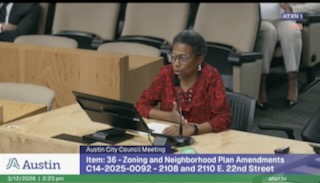
The Blackland Neighborhood Association, led by their President Marva Overton, said the “encroachment” of commercial business into the residential area would damage neighborhood character and likely set a precedent for future cases. They also worried that it would exacerbate already bad parking and traffic problems in the neighborhood.
As we reported, the Planning Commission dismissed those concerns and passed a motion recommending Council approval of the case. The vote was 10-1 vote, with only Commissioner Danielle Skidmore voting no. (Members of the Planning Commission are appointed by the Mayor and Council Members.)
The proposed zoning and neighborhood plan change for Montopolis was for a mixed use development, including apartments. It would have stretched along Montopolis Drive between Fairway and Caddie streets; and gone a couple of lots back into the single- family neighborhood. The developer had recently scaled back earlier plans to build 90 feet under the DB90 ordinance and was now proposing 60 feet.
The development would have been transformative for at least that section of Montopolis Boulevard, if not the whole neighborhood.
The defeat of these two cases was also the first City Hall victory in quite a while for the Austin Neighborhood Council (ANC). Jeffery Bowen, President of the ANC spoke against both the Blackland and Montopolis items. In particular, in his testimony on the Blackland case, he gave the Council something to think about. That came in the form of a report on the Planning Commission’s handling of that case.
Bowen got right to the point: “I actually sat through the Planning Commission the night that they heard this,” the Blackland case. “I was absolutely appalled at the way that the Commission treated the people that spoke, the Overtons, former Council Member (Ora) Houston. . . Honestly, it was very disturbing, and so I vowed that I would come down here and speak to this.” He added that the ANC board had also voted to oppose the case.
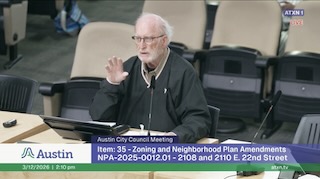
Bowen continued, “It was very obvious that their minds were already made up, that all this was going to be upzoned. The lack of respect, the lack of even wanting to listen to a long established neighborhood and long established neighbors in that neighborhood, I just found it egregious.”
Now, let’s look at how all this played out on the dais.
The Quiet Parade of No Votes
Around 3:40 Council Member José Velasquez, who represents the Montopolis area, led off the parade by asking to be listed as voting no on the two Montopolis items (as in the Este case both items were about the same address, one was to change zoning and the other was to change the neighborhood plan). Velasquez gave a short speech saying he would vote no.
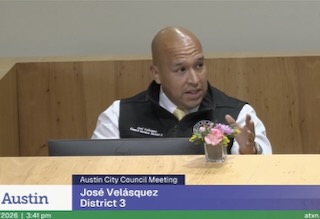
His comments included: “Montopolis continues to feel the impacts of gentrification, including displacement of longstanding residents. And we need to see a supply of quality, affordable, transit-oriented housing that allows essential workers doing vital jobs to stay in their homes. With that Mayor, I will be voting no.”
There had been some foreshadowing of problems for this case. Besides for the aforementioned indefinite postponements, Velasquez voted no at first reading on February 26 — although he did not explain why. Ryan Alter and the Mayor also registered no votes and Marc Duchen abstained.
Following Velasquez remarks on March 12, Council Member Marc Duchen criticized the “challenging and opaque (zoning) process.” He said it needs to be reformed and that consequently he would abstain on both the Blackland and Montopolis cases.
That meant there were only nine possible votes for the zoning changes, with six needed to pass. That would not have been a challenge at previous Council meetings. But, something different happened this time. First though the Council heard from Council Member Natasha Harper Madison who was supporting the Blackland zoning change.
Harper Madison’s Take
In another extraordinary happenstance, Harper Madison was actually on the dais, rather than participating remotely from behind a gray box on the Council Chamber screens. Among other things, she argued that the City Council should not be the body to decide zoning cases. She said that a criteria for a new zoning process should be: “Does it put us in a position for community members and Council Members to have good relations that aren’t contentious for no damn reason.” She added, “More often than not your Council Member has no motivation or reason to vote against your best interest.”
She continued that if Council Members weren’t put in the position of being “the negotiator, the mediator, between communities and developers we wouldn’t find ourselves on opposite sides of the thing so frequently, which makes every other discussion virtually impossible. People are stubborn once they decide they don’t like you.”
Harper Madison continued, “they’ll not work with you for the remainder of time. Cardi B said ‘forever’ and they bringing that beef forever, even to the detriment of themselves and their communities.”
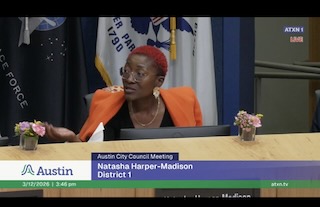
Harper Madison did not offer any specific alternative to the Council being the body to decide zoning cases. Instead she turned her fire on neighborhood associations, saying, “There’s no way for us to make certain that neighborhood associations are operating with any degree of compliance, hosting elections, being inclusive, following their bylaws, taking notes, because we don’t check. . . I think we should all come to some fair agreement of what we should be able to expect from the representatives of neighborhoods. Let’s make certain that the people in the room are in fact speaking for most of their neighbors.”
Back to the Vote Count
Once Harper Madison was done the Mayor asked if anyone wanted to be shown voting no on any of the “consent” items. This is a usually perfunctory step which may or may not draw a no vote or two on an individual case, or a recusal. This time was different.
Mayor Pro Tem Chito Vela said he would vote yes on the Montopolis item to change the neighborhood plan, but no on the zoning. This meant Vela was a yes on the Este/Blackland item.
Next, Council Member Zo Qadri asked to be shown as voting no on both the Blackland and Montopolis items.
Mike Siegel then asked to be shown as a no vote on the same items.
At this point the Mayor, pointing out that he knows how to add and subtract, proposed to remove the Blackland and Montopolis items from the consent agenda. No one objected. The remaining consent agenda then passed unanimously, without the Blackland and Montopolis items.
Next, Harper Madison made a motion to approve the two Blackland items on first reading. Chito Vela seconded. The mayor said, “Let me ask if there is any discussion?” This was followed by silence from the Council.
The mayor then asked for a show of hands of those voting in favor. In addition to Harper Madison and Vela, Ryan Alter, Krista Laine, and Paige Ellis raised their hands. Stunningly, that was only five.
Then the Mayor asked those voting no to raise their hands. Velasquez, Qadri and Siegel all raised their hands and were joined by Vanessa Fuentes. The mayor did not raise his hand either time. So it was unclear how he was voting.
But he announced, “There being five votes in favor, five votes in opposition and one abstention the motion fails.” This was a bit confusing given that the Mayor had not raised his hand for either yes or no, and never indicated in any way how he voted. He then proceeded to clear that up, albeit in a sort of offbeat manner. He read out who voted yes and who voted no. At the end of the list of no votes Watson said, “and the Mayor.”
And, just like that, for what appears to be the first time since at least 2022, the Council turned down a zoning proposal.
Mayor Watson then quickly moved to the Montopolis case. Velasquez, having already announced he would vote no, made a motion to deny both Montopolis items. Vanessa Fuentes seconded. The Mayor asked for a show of hands. Now there was a stampede. Ryan Alter (who voted no on first reading), Krista Laine and Paige Ellis joined the no votes from the previous case; Velasquez, Fuentes, Qadri and Siegel. Chito Vela had earlier announced that he would vote yes on one item and no on the other. Right before the vote, Harper Madison said she would vote like Vela. Vela and Harper Madison were the only two no votes on the first Montopolis item, to deny the proposed change in the neighborhood plan. Duchen abstained.
The zoning change went down 10-0, with Duchen abstaining. As on the previous vote the Mayor didn’t indicate how he was voting during the raising of hands, but once again recorded himself as a no vote.
What Happened? What Was Different?
Since none of the Council Members — except Velasquez on the Montopolis items — took the time to explain their no vote, it is not possible to know why they voted the way they did. It seems that at least some discussion or explanation might have been merited, given the extremely unusual nature of what was occurring. Plus, the two cases they turned down were very different. On the East 22nd Street it could have been that the majority just accepted the neighborhood association argument that commercial zoning should not intrude into the residential area of the neighborhood. But no one gave any indication whether that was the case.
On the Montopolis case, perhaps those voting no on that one just felt like it was too big for the area. So why not say that? As already noted, at least on this one, Velasquez did explain his vote. The trouncing of the Montopolis item might also reflect Velasquez displaying some skill in winning votes behind the scenes.
Nonetheless, the sudden flurry of no votes leads to the suspicion — at least in this reporter’s mind — that the voting down of the two cases was tied to upcoming elections. Velasquez and Qadri both face reelection this November. Fuentes has already been telling people that she’s running for Mayor in 2028, as if that weren’t apparent from her maneuvering on the Council. Siegel also appears to harbor ambitions for higher office. Ellis and Ryan Alter, latecomers to the no vote parade, are also running for reelection this year.
The sudden flurry of no votes leads to the suspicion — at least in this reporter’s mind — that the voting down of the two cases was tied to upcoming elections.
Then there’s the Mayor. He is term limited from running again and he’s got almost three more years left in his term. So it can’t be the upcoming election. Also, Watson never explains a vote in the Council Chambers. So, for now anyway, we won’t try to figure it out.
The impending elections, and the lack of Council explanations for their votes, adds to suspicions that they were only trying to get their no votes recorded so that opponents won’t be able to use it against them later in the November elections; and simultaneously perhaps prevent some of the people in the audience from supporting any of those opponents.
The no votes, accompanied by silence, even raise the possibility that the Council Members were individually pandering and failed to realize that the cases were going to fail to gain a majority.
By the way, none of this analysis or speculation is intended to take anything away from the efforts of the Blackland Neighborhood Association or the coalition of forces who teamed up against the Montopolis case. Blackland residents presented a very strong and well organized case and brought with them a lot of gravitas based on the history of the neighborhood and some of its members.
On the Montopolis case the opponents were also well organized and turned out a large number of speakers. But, these things have not worked before.
In conclusion, even if the Council Members took this path for political reasons the residents still made gains. Any people involved in governance and political issues always work with the conditions in place at that time. The Blackland residents beat back the commercial zoning proposal, even if the Council did it for politically selfish reasons. The development in Montopolis that so many feared is not going to happen, at least not any time soon.
* Correction: In our immediately previous story I stated incorrectly that Ora Houston was the first Black woman to serve as an Austin City Council Member. That honor actually belongs to Sheryl Cole. The correction was made quickly after the story appeared and noted at the bottom of the story. But, it merits being included here too. The Austin Independent apologizes for the error.
Looking Ahead: The Austin Independent is working on some deeply researched stories that look into the ideological underpinnings that guide the City Council supermajority and some County officials — not to mention a series of proceeding City Councils. We have several such stories in production, but wrestling them to the ground and into print may require us to take a few weeks off from publishing. So don’t be surprised if you don’t hear from us for a few weeks, but we will be back stronger than ever.
___________________
Folks: To help us keep publishing stories like the one you just read and the upcoming ones, please consider subscribing or contributing to the Austin Independent. Local, independent journalism is very poorly funded and also badly needed. To subscribe or donate, click here.
To receive notification when the Austin Independent posts stories, to subscribe, or to write to the editor please send us an email under Contact on the home page,or click here.
The Austin Independent, a publication of The Austin Independent, LLC
All Rights Reserved