
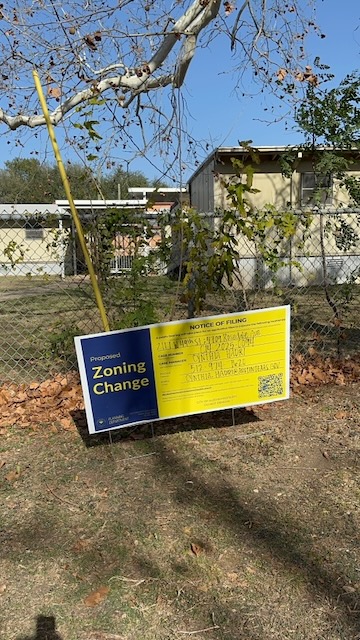
It’s getting to be a little late in January, but nonetheless let’s take a look at some of the stories coming up this year and even look back briefly at a few events that occurred during our holiday break.
Let’s begin with the desperate financial situation in which leaders of the Austin Independent School District (AISD) find themselves. This ongoing issue will rightly garner a lot of headlines this year. We don’t have the bandwidth to provide ongoing detailed coverage of the school district here. But, while we’re still close to the first of the year, let’s take a quick look at some of the basic issues.
First of all, a majority of the AISD board voted late last year to close ten schools. Now there is talk of that number shrinking slightly, by one or two schools. The closings are part of the District’s response to financial challenges and declining student population. The District hopes to make money by selling the properties, many of which are located in seemingly prime locations for commercial development.
Clearly, the District and its board have to take actions to deal with this ongoing crisis. District management and members of the school board deserve some credit for being willing to tackle the situation and make controversial decisions. Nonetheless, their decisions should be open to scrutiny. For instance the sale of properties to make money has some logic to it, but also begs the question of whether this approach will just generate one-time funds — with the District continuing to face similar crises every year going forward.
It also seems fair to question whether the board failed to see this coming. For instance in 2022 they put forward a bond election totaling $2.4 billion, which voters approved. Well, a solid chunk of that money was spent on schools that the District now plans to close. As the Austin Current (formerly the Austin Monitor) recently reported: “more than $95 million in bond money already had been spent or committed to campuses headed for closure (when the board voted to close the 10 schools).”
At the same time, no discussion of AISD’s predicament is complete without noting the impact of the state’s “recapture” law, also known as the Robin Hood system. This system was created in 1993 after years of lawsuits challenging the state’s education funding system – or lack thereof. It takes a portion of school property tax payments from districts with high property values and reallocates that to districts with low property values.
With Robin Hood, the Texas Legislature — in their collective wisdom and creativity — devised a system under which Austin taxpayers pay far more than any other place in Texas. As the Austin American-Statesman explained in a December 1 story, “Austin pays the largest dollar amount back to the state of any district by far, an expected $629.1 million this year.” The Statesman also points out, “almost half of what a local (Austin) homeowner pays toward education actually leaves Austin,” to fund education in “property poor” school districts.
With Robin Hood, the Texas Legislature — in their collective wisdom and creativity — devised a system under which Austin taxpayers pay far more than any other place in Texas.
So, given the recapture system, combined with falling enrollment, AISD clearly faces a desperate situation. And, as the late Austin singer-songwriter Jimmy LaFave wrote, “desperate people, do desperate things.” That brings us to the District’s plans for the former Rosedale Elementary. The school is located between Ramsey Avenue on the west and the back of a strip of businesses that front Burnet Road, and between 48th and 49th Streets. It operated for many years as an elementary school and then, according to AISD, as a school for children with special needs from 1988 to 2022. It closed after a new school for children with special needs was opened. In recent years the property has been used for AISD administrative purposes.
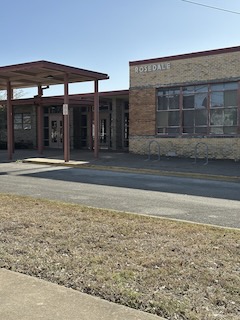
The former Rosedale elementary school – this photo and photo at top by Adela Mancías
Importantly, as noted in the above description, the property does not front on Burnet Road. It is nestled into a neighborhood of single family homes, in the relatively small section of the Rosedale neighborhood located north of 45th Street. Generations of families loved the school, but neighborhood residents are overwhelmingly opposed to the new proposed use (as evidenced by signs in almost every yard of the neighborhood, which read “Play Fair with Rosedale”).
AISD plans to sell the property to an apartment developer for a 435-unit complex. There is a zoning case pending before the City Council intended to make that possible. Among other things, neighborhood residents argue that the proposed development would exponentially increase traffic in their quiet, tucked-away community.
The District, however, ran into a legal snag. Lots in the neighborhood have a 1938 deed restriction which reads, “no lot of this subdivision shall ever be used for any other purpose than that of a residence.” As neighbors point out on their website, “For 87 years, this has always meant a house, along with ‘accessory uses’ like a garage or garage apartment.”
AISD management took the highly unusual step of suing the homeowners, its constituents. They are asking the court to determine “that development and use of the property for multifamily residential purposes is not prohibited by the governing restrictive covenants.”
AISD management took the highly unusual step of suing the homeowners, its constituents.
The lawsuit features further information, some of which, on the surface, seems to work against AISD’s case. In doing so the suit also provides a bit of history. According to the lawsuit, in 1938 — a few months after the neighborhood deed restrictions had been created — the school district purchased 19 lots in the subdivision and residents agreed to release the land from the residential deed restriction, on the terms that the lots be used “for public school purposes.”
At least one AISD official has acknowledged that the process on Rosedale is highly unusual. The Statesman quoted Kenneth Walker, identified as the district’s legal counsel. Walker said, ‘“This is not the way we normally sell property.”’ Walker further explained, ‘“We normally engage the community and make sure their input is reflected and in this instance, we’re pretty restrained.”’
Meanwhile at City Hall
Given the problems and the desperation at the school district, it’s good to know that the City of Austin has its priorities straight. I’m just kidding. I threw in a joke there to lighten things up.
Over the holidays the City sent a letter demanding that a political group stop using a parody of the new City logo. They really did that. The letter was signed by private attorney Dwayne Goetzel, who is representing the the City on the logo issue.
The alleged offender, and recipient of the letter, was Matt Mackowiak and the group he co-leads, Save Austin Now. A similar parody had been circulating online weeks before. Mackowiak told the Austin Independent that Save Austin Now saw that parody and then “created our own.” Both portray the “A” of the City’s logo as standing for “Audit.” Mackowiak is leading a petition drive to get an item on the May ballot forcing the City to undertake a comprehensive audit.

Screenshot from Save Austin Now Substack page – still up
The letter said, “As you may know, the City was the first to use the stylized ‘A’ mark, which is the subject of trademark application serial nos. 99366739 and 99366743. You are using the stylized ‘A’ mark on the foregoing sites (Save Austin Now websites), which is an infringement of the City’s trademark rights. Your unauthorized use of the ‘A’ mark will confuse consumers who may believe that your use is sponsored or approved by the City. In order to prevent confusion and avoid harming the goodwill in the City’s trademark, we request that you immediately discontinue all use of the stylized ‘A’ mark, or anything confusingly similar to it.”
Goetzel added in a second and final paragraph, “we are not objecting to your First Amendment rights to discuss city government matters, only to the use of the City’s trademark.”
Mackowiak responded defiantly, telling the Statesman, “That logo is a perfect encapsulation of so much of the problem at City Hall right now – outrageous wastes of money, embarrassingly poor judgments, a complete and total disregard for taxpayers, and a lack of transparency and accountability.”
Save Austin Now also filed a lawsuit asking for a “permanent injunction” to prevent the City from “interfering in Plaintiffs’ exercise of their rights, including their right to criticize the Broadnax Logo and use it as parody free speech” The lawsuit was signed by “Counsel for the Plaintiffs” Bill Aleshire.
I have no idea how the suit will turn out, but if I was a judge in this fight I would have to say that Mackowiak won the first round in the media. It was like Christmas came early for him.
Is the Convention Center’s Fate to Remain a Hole in the Ground?
Now let’s turn to another City issue featuring a petition drive and a lawsuit — the construction of a new convention center. A citizens group, Austin United Political Action Committee (Austin United PAC or Austin United), led in part by Bill Bunch of the Save Our Springs Alliance, last year conducted a petition drive to prevent construction of a new convention center. This issue is complicated by the fact that the old convention center is almost completely torn down already. One could argue that that fact makes this issue crazy even for Austin. On the other hand it could be argued that the City, knowing they were facing a petition drive that could prevent construction, should never have moved forward with demolition.

A photo taken January 17 of the Austin Convention Center site – photo by Daryl Slusher
That argument will have to wait, at least for now. The group turned in their petitions in mid-October. In mid-November City Clerk Erika Brady ruled that the group’s submission did not contain enough valid signatures. On December 15, Austin United filed a suit against the City maintaining that Brady erred in disqualifying their submission.
Here we turn to a very informative article by Andrew Wheat in the Austin Free Press, published on December 16. Wheat reports that Brady “sampled about a quarter of the 25,441 signatures and declared that the petition fell an estimated 494 verified signatures short of the 20,000 needed to be put on the spring ballot.” The suit, he continues, maintains that the Clerk: “improperly disqualified ‘the signatures of qualified voters who are plainly on the voter rolls or who are otherwise readily identifiable by the information submitted.’” Summarizes Wheat, the plaintiffs maintain that Brady “improperly struck signatures of people who printed their names, changed addresses within city limits, or used a post office box. It also claims that the clerk wrongly excluded 315 voters who reside in the city’s extraterritorial and limited purpose jurisdictions.”
But, continues Wheat, “At the center of the case is the city’s refusal to release the sampling information and methodology used to determine that the petition fell short of the requisite 20,000 validated voter signatures.”
Wheat explains: “City Attorney Deborah Thomas told the Austin United (PAC) in a Nov. 26 letter that the material is not ‘public information’ and that the city ‘does not have’ the data produced by University of Texas statistics professor Thomas Sager. The city paid Sager $875 to produce the analysis, according to city records that Austin Free Press obtained through a separate Public Information Act request.”
First of all, let’s note that Professor Sager does not appear to be one who tries to milk the City treasury, given the three figure payment he evidently received for his services. Now, to summarize the City’s claim, they are saying that they hired a local professor to devise or apply some sort of formula to determine if the submitted petitions had enough valid signatures. The professor’s method found that there were not enough valid signatures. But, the City says the formula and other information or methods that the professor used are not public records, and the City doesn’t have the information anyway — although one would think that they must have had it at some point.
This contention by the City, continues Wheat, “has ignited a broader dispute over transparency.” He then quotes James Hemphill, a local attorney who is on the board of the Freedom of Information Foundation of Texas: “My general statement is that the Public Information Act is intended to be applied broadly in favor of transparency and it would seem, just as a matter of public policy, that this is the kind of thing that should be made public.”
Wheat next turns to John Bridges, current “UT journalism lecturer” and “a former executive editor of the Austin American-Statesman.” Clearly a wizened observer of local Austin politics, Bridges begins by observing that the whole issue is ‘“kind of crazy given the thing (old convention center) was in ruins at the time.”’ Nonetheless, continues Bridges, ‘“This is certainly a matter of public interest, and it seems to me that that is still a public record that the city would be required to produce under the Public Information Act.”’ Even if the City farms “something out to a third party,” Bridges summarized, “it’s still a government record.”
As with the logo, the legal verdict is not in yet. If anyone wants to know more about this issue, I recommend reading Wheat’s article in full.
Supreme Court rules for Republicans in redistricting case – Doggett confirms he will retire
In closing let’s note a historic turning point in Austin politics. Over the holidays the US Supreme Court ruled in favor of Republicans in a lawsuit challenging the Texas’s legislature most recent gerrymandering. The gerrymandering was done at the request of President Donald Trump, in an attempt to improve Republican’s chances of holding their slim House majority in this year’s midterm elections.

Congressman Lloyd Doggett and his wife Libby, from his Instagram page
That means that longtime Austin Congressman Lloyd Doggett will now definitely retire. In brief, the legislature redistricted Doggett and Congressman Greg Casar into the same District, now encompassing almost all of Austin except for a large chunk of West Austin. Casar previously represented a District including much of Austin east of IH 35 and stretching to San Antonio. Last year Doggett urged Casar to run in his (Casar’s) redrawn District. Doggett explained how he thought Casar could win the redrawn District and take one of the new seats on which Republicans were counting.

Casar announced that he would instead run in the Austin District. Doggett then announced that he would retire to avoid an intra-party battle, if the redistricting stood up in Court. In December a Texas judge ruled against the redistricting plan, raising the possibility that Doggett might run again. With the Supreme Court ruling, however, the Congressman, who has served Austin in Congress since 1995, announced that he would not run.
Casar is now likely to skate into the seat with no serious opposition.
___________________
Folks: As we’ve mentioned before local, independent journalism is very poorly funded. Please consider starting the year by subscribing or donating to the Austin Independent. It will help us, for example, to expand our readership base and to pay for important public information requests. To subscribe or donate, click here.
To receive notification when the Austin Independent posts stories, to subscribe, or to write to the editor please send us an email under Contact on the home page,or click here.
The Austin Independent, a publication of The Austin Independent, LLC
All Rights Reserved