
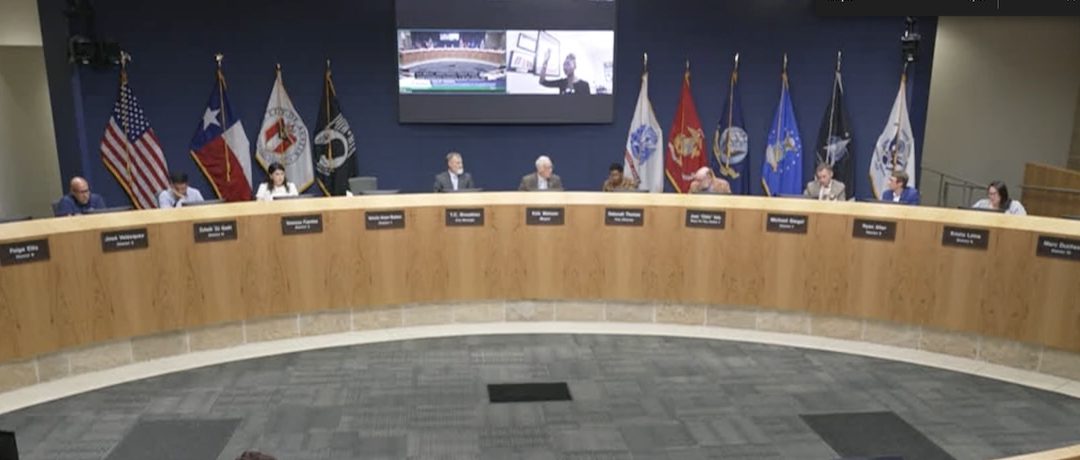
Council Member Natasha Harper Madison is very concerned about the future direction of voters in District 1, the Council District which she currently represents. Here’s what she said at a Council meeting on July 30:
“As the lone Black Council Member on the Council, living in a country with the type of federal administration we have, and the kind of people who are being emboldened by our federal administration, I’d like to say my District is low voter turnout, in which case I don’t want future-facing Black political power to be at risk because we have low voter turnout, and the people who would find nefarious purposes, use this tool to vote out a Black Council Member, to recall a Black Council Member, for no other reason except that they are a Black Council Member concerns me.”
The context for this statement was a Council discussion over whether to put a proposal on the November ballot to increase the number of signatures required to force a recall election of a Council Member or the Mayor. Such a measure would have to go before voters because it would be an amendment to the City Charter. This proposal dates back to 2024 when it and some other Charter amendment ideas met with harsh public reaction. Then, a successful lawsuit by the Bills (Aleshire and Bunch) derailed the whole effort to have a Charter amendments election in 2024. By the time the item returned to the Council agenda, on July 30 of this year, all Council Members except Harper Madison had abandoned the idea. Thus, she asked for the floor and gave the explanation quoted, in its entirety, above.
Why Bring This Up?
Both the Austin Free Press and the Austin American-Statesman published the quote from Harper Madison in their stories about Council setting the local ballot for November, but with no further comment. I interpret the decisions of the Austin Free Press and the Austin American-Statesman to note this particular Harper Madison statement as an invitation to discuss it further — maybe even a cry for help.
I think there are some things that need saying.
I will discuss a little further down why the possibility apparently feared by Harper Madison is extremely unlikely to ever happen. But, statements like the one she made don’t need to be factually correct or even remotely possible. Such statements depend on people being afraid to respond or to question what was said; because they are afraid of being called a racist, or have it insinuated that they are a racist.
In my view this is a terrible way for human beings to relate to each other. Among other things it stifles discourse on critically important issues. It puts barriers between people when there don’t need to be any. It is also a horrible way to govern.
This is a national, even international problem, but we certainly have our version here in Austin. And, it’s not limited to Harper Madison. For example, until very recently the City’s Equity and Inclusion Office stated on their About page, on the official City website, that the City of Austin engaged in “segregationist policies throughout the 20th century.” The statement stayed up for almost a decade. Further down I will describe what happened when I asked the Equity Office to name the “segregationist policies” practiced by the City during the last three decades of the 20th Century. But, for now let’s turn back to the comments by Council Member Harper Madison.
Remote Comments, Remote Reality
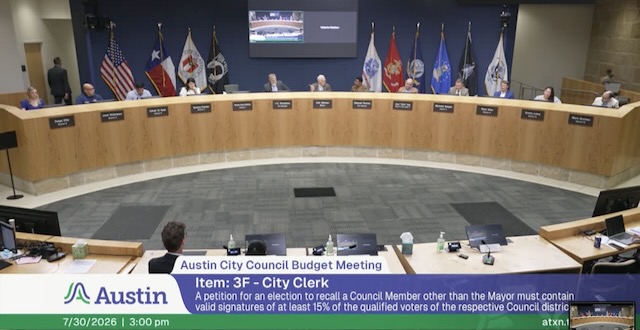
First of all Harper Madison wasn’t actually at the Council Meeting, not on the dais anyway, like the Mayor and the other nine Council Members. As she often does, Harper Madison was participating remotely from behind a large gray box with her name on it that took up half the large screen on the wall behind the dais. Only when she wanted to speak did her image appear on the screen.
Now, let’s try to summarize what Harper Madison said. She is saying that she fears that, at some time in the future, an assemblage of District 1 voters — large enough to command a majority in a local election — might conduct a petition drive to force a recall election intended “to vote out a Black Council Member, to recall a Black Council Member, for no other reason except that they are a Black Council Member.” And she’s saying the possibility of this happening is greater because District 1 “is low voter turnout.”
I think that’s a fair summary which incorporates the various points the Council Member made and the viewpoints she reflected. Readers, please take your own approach to that if you want. Now, let’s examine her points.
First, I’m not going to deny that the Trump administration might have “emboldened” some racists out there, but let’s stay locally focused because Harper Madison’s remarks specifically had to do with voters in District 1 and future voters there — in the district that elected her twice.
I know things can change over time, but getting to something like what Harper Madison envisions would take a seismic shift. On the 2024 precinct by precinct election map Harper Madison’s District 1 features some of the darkest blue spots (Democratic) in the entire state of Texas. For instance Kamala Harris won 85% in both precincts 102 and 103 which are just east of IH 35 between East 12th Street and Manor Road. Just south of there Harris dropped to 82% in one precinct and sunk to 79% in another.
At the kindest Harper Madison is insinuating that a cabal of people — either from the District that twice elected her or from outside the District — will organize a “nefarious” effort to remove someone from office “for no other reason except that they are Black.” And, she is assuming that a majority of the people who turn out to vote in the District would support — or fall for — an effort to remove someone from elected office simply because they are Black. If one thinks about it a little it seems perhaps a tad insulting to her current constituents. And, it’s difficult to believe the District would change that much. I mean the area has consistently voted overwhelmingly Democratic for decades.
A Short History of Black Elected Representation in Austin
Now let’s take a quick look at the history of Black representation on the City Council and at other levels of government. The Council was an all white affair from the 1880s until 1971 when, in the wake of the Civil Rights Movement, Berl Handcox, a Black man, was elected. Then in 1975 John Treviño became the first Mexican American elected to the Council. During this era an unofficial agreement was forged for one seat on the then seven member Council to be unofficially reserved for a Black representative and another for a Mexican American. This arrangement was called the “gentlemen’s agreement.”
As time passed many criticized this system as patronizing and tokenism, often stopping just short of calling it racist. The core argument was that whites were the majority of the electorate and so they were picking the Black and Mexican American members on the Council. I once even made this criticism myself in the Austin Chronicle. Nonetheless, in most election years White majorities tended to go for the same candidates as Black and Mexican American majorities.
Criticism of the “gentlemen’s agreement” was a major aspect in the drive for single member districts which voters finally approved in 2012, with the system going into effect in 2015.
Ironically the current District 1, intended as a Black “opportunity district” under the single member district system, does not have a Black majority either; nowhere near it. Only 22.4% of District 1 residents are Black. Yet, like with the “Gentleman’s Agreement,” there is a semi-tacit agreement that the area will be represented by a Black person. The same is true, although the percentages vary slightly — for the school district, County Commissioners Court, and the state legislative seat encompassing roughly the same area. That’s been the case since the 1970s (1981 in the case of the Commissioners Court).
Among other things, this arrangement means that everyone who lives in District 1, but is not Black, loses their right to run for any of these seats. Folks may read that as white people not being able to credibly run for office in this area, and that is true.
But the unofficial agreement also includes Mexican Americans and Asian Americans, anyone who is not Black. Mexican Americans in fact have a demographic plurality in the District, 39%. Whites make up 29%, Blacks 22% and Asian Americans just short of 9%. Yet under the semi-tacit agreement, a Mexican American is not allowed to run for or hold this seat.
Not all accept this. For instance before he was elected to the City Council Chito Vela ran for the legislative seat vacated by Dawnna Dukes. Cries were heard that this would mean no Black representation in the Travis County legislative delegation. Vela pressed ahead, but lost narrowly to Sheryl Cole.
In my view the gentleman’s agreement and single member districts are both imperfect attempts to do a societal good — insuring Black and Mexican American representation — in a complicated social and numerical situation. It is particularly complicated for the smaller Black population. Under single member districts Mexican American representation on the Council has increased.
In any case, is it really a serious possibility that a District of around 100,000 people, who collectively operate on the principle that only a Black person can be elected to represent them, is going to evolve into a racist hellhole that will kick people out of office just because they are Black. Harper Madison’s reasoning is so garbled that under her scenario voters in the same District would first elect a Black person and then remove them “for no other reason except that they are Black.”
I think that’s where “low turnout” comes into her imagined scenario.
“Low Voter turnout”
Harper Madison says twice that a core reason she is concerned about the potential scenario of “a Black Council Member,” being recalled “for no other reason except that they are a Black Council Member” is that “my District is low voter turnout.”
It appears to me that when Harper Madison talks about “low voter turnout” she is talking about Black voters. I base that primarily on her saying, “I don’t want future-facing Black political power to be at risk because we have low voter turnout.” I didn’t want to assume that’s what she meant so I emailed her and asked. I didn’t hear back. So I will proceed with the presumption that that is what she meant.
Black turnout does sometimes lag behind White turnout, and turnout in District 1 has been near the lowest in Council elections — but not the lowest.
Supposing low Black turnout in the recall scenario imagined by Harper Madison, however, assumes that people from the race and tradition that organized, demonstrated and overturned the brutal Jim Crow system and bled to get the Voting Rights Act would fail to turn out for an election aimed at kicking someone out of office just because they are Black.
Another shortcoming of the “low voter turnout” argument is that traditionally people expect a more aspirational and determined approach from their elected leaders; for example working to do something about “low voter turnout,” as opposed to just declaring it a fact.
Also Harper Madison’s idea of toughening recall requirements in order to protect “future-facing Black political power” from “low voter turnout” is an entirely new concept for government. There’s no tradition of government establishing protections for groups with “low voter turnout.” I mean, disenfranchised groups, like former slaves after the Civil War or Blacks in the South during Jim Crow, fought and protested for voting rights. They didn’t ask to be protected from “low voter turnout.”
Harper Madison’s idea of toughening recall requirements in order to protect “future-facing Black political power” from “low voter turnout” is an entirely new concept for government.
And, lastly, I hate to bring this up, but Harper Madison’s “low voter turnout” assumption doesn’t require any personal responsibility from voters in the District. It’s just assumed that there will be “low voter turnout.
OK, I know that bringing up “personal responsibility” in racial discussions is in some quarters considered a racist dog whistle. I disagree. I think personal responsibility is a trait and habit that humans of all races should embrace. And, I refuse to give up my right to state that openly, or to say anything else that I believe.
Austin Equity Office: “Segregationist Policies Throughout the 20th Century”
I stated earlier that the City’s Equity and Inclusion Office provided a clear example of how racially charged statements are often inaccurate and unsubstantiated, but depend on people being afraid to question them or point out inaccuracies. What follows is a short summary of exchanges I had with the office — over a few years time — about a claim which I believe fits into that category.
For close to a decade, and until recent weeks, the Equity Office’s website featured a short history of Austin which included this statement: “Throughout history, communities of color have been excluded, marginalized, and discriminated against as a result of City policies and practices. This history was reinforced by segregationist policies throughout the 20th century affecting a range of Austin venues, including schools, public parks, and commercial businesses, among others.”
The first sentence is true, but “throughout the 20th century?” I mean the Civil Rights Act of 1964 — pushed through Congress by Central Texan Lyndon Johnson — outlawed segregation and ended Jim Crow. Not all prejudice disappeared, but over the last three decades of the 20th Century the City of Austin developed a very diverse workforce at all levels, the first Blacks (since Reconstruction) and Mexican Americans were elected to the City Council and at all levels of government. And, voters passed a number of bond issues with large amounts of funding for projects in East Austin. That’s not to mention that people of all races were free to frequent any businesses, venues or institutions that they wanted.
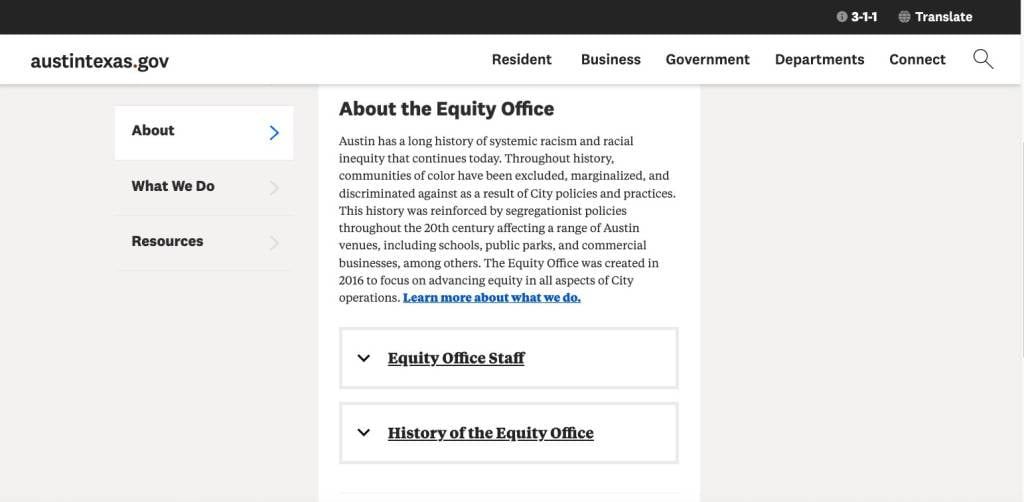
About page of the Austin Equity Office for almost a decade
So I wrote to the Equity Office in September 2022 and asked for examples of City “segregationist policies” during the last three decades of the 20th Century. I also asked for the Department’s definition of segregation. (I breifly reported on that once before.)
They replied and were very clear in their definition of segregation: “Our definition aligns with that of Ibram X Kendi’s, an American author, anti-racist activist, and historian. Segregationist policies grow from segregationist ideas, which hold that people of color cannot be developed to White standards. Segregationist ideas suggest that a racial group is permanently inferior. Segregationist policies are geared toward segregating, enslaving, incarcerating, deporting, and killing people of color and often, if not always, produces such outcomes.”
Yes, that’s pretty clear, but they were much less clear in naming specific “segregationist” City policies. The Equity Office failed to name a single City policy for the 1970s instead talking about “racially biased federal policies” that contributed to “suburbanization.”
For the 1980s they listed “exclusionary zoning” that was “used to exclude multifamily housing from many residential neighborhoods.” But, for decades predominately Black neighborhoods and neighborhood associations frequently opposed apartment complexes inside single family neighborhoods; and still do
For the 1990s the Equity Office cited the “Desired Development Zone (DDZ)” and “the City’s watershed protection regulations,” which were not as strong in the east as in the west.
The exact same website was still up in January 2025 when I wrote back with some follow-up questions. Among other things I asked them to clarify if they still felt that the City’s watershed ordinances and the Desired Development Zone met their definition of segregation. I also offered some bullet points on watershed ordinances and the DDZ and asked if that changed their view at all on those being “segregationist policies.” I pointed out that during the 1970s, ’80s and ’90s leadership in the Black community and to a slightly lesser extent in the Mexican American community adamantly favored economic development over environmental protections. I also explained that the geology of East and West Austin are different; the western parts of Austin and Travis County either drain into the porous Edwards Aquifer or the Colorado River — everyone’s drinking water supply. Thus the ordinances were passed to protect the drinking and recreational water supply for everyone. I then asked if, given this information, they still felt like these were “segregationist policies.” I added that if they answered yes, to please explain how the policies met the Kendi/Austin Equity Office definition of segregation.
The Equity Office replied by withdrawing their definition of “segregationist policies,” and not replacing it.
They wrote,: “To be clear, the City of Austin does not have an official definition for ‘segregationist policies.’ The Equity Office’s 2022 response should have clarified that point and that the City strives to ensure that policy and programs are equitable and avoid outcomes that harm communities of color and low-income populations in Austin.”
“To be clear, the City of Austin does not have an official definition for ‘segregationist policies.’ The Equity Office’s 2022 response should have clarified that point.
Then the Equity Office acknowledged that the two policies that they originally maintained were “segregationist,” — with the Kendi definition of “enslaving” and “killing” people of color and “people of color cannot be developed to White standards” — were actually “not based on racial prejudice.” They added that the Desired Development Zone still “harmed people of color and lower-income people.”
The Office still kept the website up until recent weeks. This is only a fraction of my exchange with the Equity and Inclusion Office and we will provide more details in future installments.
____________________
Folks: The Austin Independent has revamped its Donate page and with a new vendor. So if you have had trouble subscribing before please head over there and give it a try. And even if you haven’t had trouble before why not celebrate with us and subscribe and/or make a donation. Local journalism costs money to produce and you will be hard pressed to find the kind of local journalism the Austin Independent provides anywhere else. Thank you.
The Austin Independent, a publication of The Austin Independent, LLC
All Rights Reserved