

When it comes to the two bond items on the City of Austin November ballot the City Council has presented voters (at least the ones paying attention) with two agonizing decisions. I’m referring to the $260 million in proposed bonds for the Parks and Recreation Department and the $35 million item for City of Austin libraries.
The core conflict is that a majority of voters clearly have concerns about the Council’s and the City’s financial management — as evidenced by last year’s overwhelming rejection of Prop Q, a Council request for voters to raise property taxes beyond the amount the Council can raise them without holding an election.
On the other hand, funding for parks in particular has not kept pace with growth. And each bond proposition contains what many Austinites would consider worthwhile projects and expenditures. For instance the parks bond includes funds for land acquisition for future parks or open space. Such land will almost certainly cost more in the future, if it remains available. In fact now could be considered an optimum time to purchase land, with the real estate market experiencing an ongoing slow down.
Another, less discussed factor, is that both libraries and parks have been plagued by violence. Frequenting either can raise real public safety concerns and it could be argued that the two departments should concentrate on improving public safety before asking voters for more funds. The violence does not seem to be much of a factor in the election, but perhaps it should be. We’ll have a bit more on that later, but first let’s look at how the Council majority managed to get the two bond propositions to comply with City financial policies.
If A Policy Is Inconvenient — Change It
Back in late May, City staff recommended against holding a bond election this year. They advised the Council to wait until 2028 in order “to maintain compliance with the City’s current Financial Policies.” In other words, staff warned the Council that holding an election this year would be not be “in compliance with the City’s current Financial Policies.” The Austin Independent asked if that is still the case.
City PIO officials explained in a written reply, “In May 2026, when City staff made the recommendation to not move forward with a bond election, this was consistent with the financial policies at the time.”
But, “On May 28, 2026, the City Council updated the City’s financial policies.”
“The new financial policies,” staff continues, “provide more flexibility.”
OK, let’s unpack that. Back in May the Council was considering a General Fund-wide/multi-department bond ballot. City staff primarily cited a financial policy that required 90% of previously approved bond funds to have been spent before another bond election is held. Staff then listed numerous departments which had not met the 90% threshold.
A Council majority pushed ahead anyway, and whittled the bond election down to just the Parks and Recreation Department and Libraries. Parks and Recreation is over the 90% threshold. Libraries is slightly below it, in the high 80%s. Those actions got the Council closer to compliance with the ““the City’s current Financial Policies,” but not entirely. There was still more work to do.
So the Council took up more changes to the financial policies on their May 28, 2026 agenda. For instance they deleted a paragraph which included the sentence, “The City shall structure its bond issuance to achieve and maintain a debt-to-assessed value of 2% or less.”
This was replaced by a new policy which reads, “The City shall structure its bond issuances and manage its long-term bond sale schedule in a manner not likely to result in a downgrade to the City’s credit rating.”
The Council also eliminated a policy which read: “The ratio of Debt Service to Total Expenditures (operating expenditures and debt service combined) shall not exceed approximately 20%.” These changes were made on a motion from Council Member Ryan Alter, seconded by Council Member Mike Siegel. The May 28 vote was seven to two. Mayor Kirk Watson and Council Member Marc Duchen voted no. Council Members Vanessa Fuentes and Natasha Harper Madison were absent.
Staff continued to recommend against a 2026 bond election despite the changes in financial policies. Then, on August 4, 2026 an 8-3 Council majority voted to set the parks and libraries bond election. Watson and Duchen again voted no. They were joined this time by Council Member José Velasquez who explained that his no vote was “about recognizing that our residents are already carrying enough.”
And that’s how the Council got to a place where staff could tell us last week, “The two bond proposals on the 2026 ballot are in compliance with the City’s current financial policies.”
Slightly Increasing Council Concerns – Watson’s Summer of Discontent
The Mayor and the two Council Members who voted no on holding a bond election this year arrived at their votes along different paths.
Duchen has been a critic of Council’s financial approach since taking office in 2025 — actually before. So this was consistent and in character for him.
Voting no is unusual for Velasquez, or was until the time approached for him to stand for reelection. In recent months he has quietly cast a few no votes, mainly on controversial zoning cases in his District. These votes were starkly in contrast to his previous record. And he made little, if any, effort to stop the zonings from being approved — making his new stances hard to take seriously. Clearly, the idea was just to get recorded as a no vote so he can say on the campaign trail that he didn’t support a particular item. On the bonds, he voted in May to change City financial policies, but by August he voted against holding an election that the May policy changes made possible.
Watson’s no vote is part of a new approach by the Mayor. Since the voters’ rejection of Prop Q last year Watson has been trying to show citizens that he got the message. He has also said publicly that he regrets supporting Prop Q. In a summer of discontent the Mayor has sometimes criticized the Council supermajority. That is in contrast to the approach he took upon taking office in 2023 — of allying with the “progressive” supermajority and keeping any disagreements (if there were any) behind the scenes.
The Mayor has diverged from that approach lately. His open criticism of the bond election process was one of the starkest examples. Before the Council voted to set the ballot at the August 4 meeting, Watson told his colleagues: “It (the Council debate) has never been about whether there are worthy projects waiting for funding. There are. The question has always been something different: can we ask taxpayers to approve new debt before we’ve honored the financial policies we adopted to protect them? Can we abandon the very process we created because the answer it produced isn’t the one some hoped for?”
The Mayor then went on to criticize the process the Council majority had engaged in: “Instead of asking what the process produced, we’ve begun asking what projects can be added to assemble enough votes on Council. Instead of listening to the recommendations of the professional staff about the best financial approaches, we’ve started asking staff to create ways to satisfy specific districts. Instead of evaluating proposals through established criteria, we’re hearing new arguments appear after the process has largely concluded.”
“Can we ask taxpayers to approve new debt before we’ve honored the financial policies we adopted to protect them? Can we abandon the very process we created because the answer it produced isn’t the one some hoped for?”
MAyor Kirk Watson
Those remarks are part of a recent pattern. Also in August, Watson actually voted against the budget — an unprecedented move for him, and a significant sign of discontent. Plus, while discussing the vote by a slim Council majority to begin a process to move the 911 call center out of the police department, Watson bluntly told KXAN reporter Grace Reader, on camera, “I think part of it is politics. It is some folks that don’t like the police department, don’t like the police budget, and so they’re using this as a means of trying to push back on the police.”
Watson also told Reader that he was “disappointed and discouraged” by the budget and budget process. Additionally, he criticized the Council majority’s rewriting of City financial policies, “I felt like those financial policies actually got watered down a little bit, so that those who wanted to have a bond election could have a bond election, and say, ‘oh, we complied with the financial policies.’ Well, if you’re only complying with them when they’re convenient, well that’s not really having a policy.'”
What Do Advocates Say the Bonds Will Fund?
A flyer from the campaign backing the bonds lists some projects that will be attractive to many Austinites, including: improvements at “Gus Garcia Recreation Center, Doris Miller Auditorium and Mayfield Park” as well as “the Williamson Creek Trail, St. Edwards Greenbelt and Park, Zilker and Circle C Metro Parks, Mt. Bonnell, Onion Creek all-abilities playground, and citywide park electrification.” In addition there are planned improvements to “Garrison, Big Stacy, Walnut Creek and Civitan pools,” as well as improvements to a variety of district parks.”
The smaller library ballot includes improvements at the Hampton branch library in Oak Hill and a new Colony Park branch library in East Austin. The planned Colony Park Library is perhaps the most attractive and most merited project. A Colony Park library would be an important addition to an underserved area. To elaborate, calling areas in East Austin underserved is sometimes incorrect, overworked and dated, but in the case of Colony Park it is true — in regard to both public facilities and private businesses.
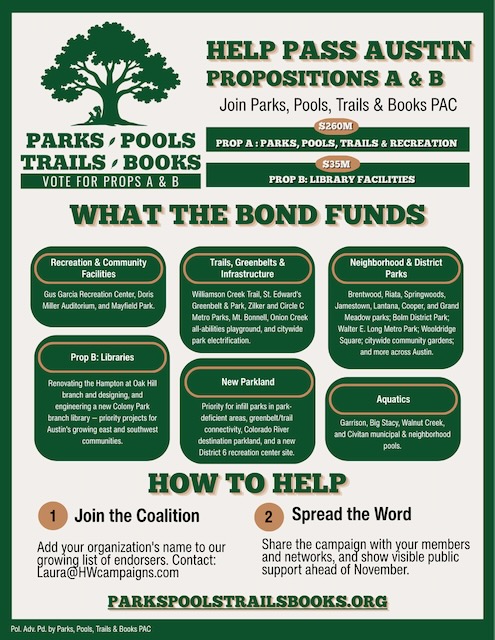
Flyer from the group backing parks and library bonds. The Austin Independent is unaware of any organized campaign againist the bonds.
Many of the parks and recreation projects are also very alluring. Austin voters have a long history of supporting parks and library bonds. And, there is an active citizen campaign to win approval of the bonds. So these bonds might win voter approval on November 3. Or, concerns about the City’s financial management and policies may lead to an unusual defeat of parks and library bonds.
Public Safety at Parks and Libraries
There is another fundamental issue that might affect the votes of some Austinites on parks and libraries. That is the ongoing decline in public safety at some of these places. I realize that some think such public safety problems are exaggerated. And I know that many Democrats feel that even bringing up public safety is a Republican issue; and people that raise the issue are suspected of being closet Republicans — not that I know from personal experience or anything. But, frankly, thinking like that is a big reason why — even as a Democratic wave is thought to be approaching while Donald Trump bungles issue after issue and concentrates on naming things after himself and building monuments to himself — the Democratic Party has a higher national disapproval rating than Republicans.
Ooops, I went off on a tangent there. Let’s get back to the parks and libraries bond election.
I’m just saying that whether the bonds win or lose, wouldn’t it be reasonable for people to expect officials in both departments, and in the City Manager’s Office, to undertake a much more serious approach to fighting violence and crime at parks and libraries? In an earlier era it would seem like the answer would be an obvious yes. But, in today’s Austin that is not necessarily the case.
I’m just saying that whether the bonds win or lose, wouldn’t it be reasonable for people to expect officials in both departments, and in the City Manager’s Office, to undertake a much more serious approach to fighting violence and crime at parks and libraries?
I bring this up because I think it is an attitude that needs to change. Some very real people have had their lives altered by violence in Austin parks and libraries — especially libraries. Let’s just look at the City’s still relatively new downtown library, which opened in 2017. It was built with $125 million in taxpayer funds. It’s a beautiful facility along Shoal Creek with some intimate views of lower downtown. It has a variety of study and meeting rooms along with well stocked sections of books over six floors, with a magnificent staircase climbing to the top.
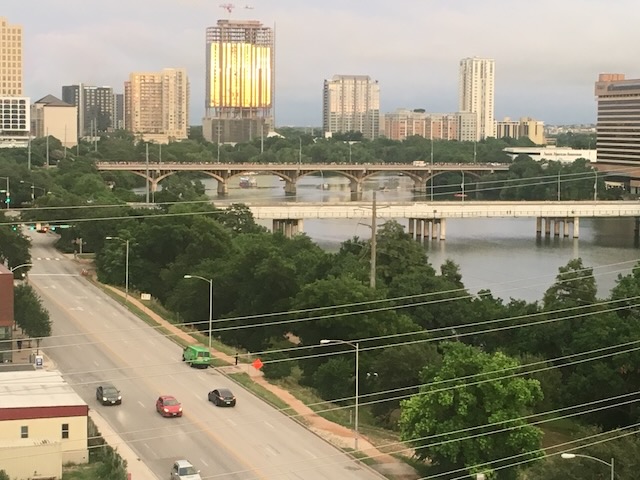
2018 photo from a balcony at the downtown Austin library. Photo by Daryl Slusher. Photo at top by Adela Mancías
But, the downtown library is also a risky place to go. Just for the two worst examples, one Saturday afternoon last October a 26-year old man visiting Austin from Waco was shot when he entered the sixth floor rest room. The apparently deranged assailant was standing on top of a toilet and opened fire when the man entered. According to the victim the two had had no previous contact.
A month or so later Fox7 checked in with the still recovering victim. He told Fox7 that the bullet “shattered my knuckle and my middle finger, it also traveled through my thigh and out my thigh.” He added that he had “temporarily lost the use of his right hand and now walks with a limp due to the bullet’s travel path.” He said his seven and nine year-old daughters have also been affected. “Like they’re nervous,” he explained.
The victim added that he is now hesitant to go to public places, “I’ve just been staying cautious and staying to myself and making sure there’s nobody around me before I do something.”
That all seems like a steep price for a weekend trip to Austin and a stop by the downtown library.
Then there was the March 2026 incident, in the middle of a weekday, when a 62-year-old man sitting quietly at a computer in the downtown library was suddenly attacked by a person who, in the Austin American-Statesman’s description, “elbowed and kicked the man before stomping repeatedly on his head.” The Statesman added that the victim sustained “severe brain injuries.”
Once again this seems like an horrendous price to pay for a morning at the downtown Austin Library. Voters would seem to be justified if they collectively said to the library and City government in general, no new money for you until you take some serious action to make libraries a safe place to visit and spend some time. But the topic doesn’t appear to be getting much discussion during the election.
The Austin Independent asked the City what has been done since the incidents to make the library a less dangerous place. The most significant thing they listed was employing off duty sheriff’s deputies. They also reported, in more boilerplate language: “Austin Public Library is dedicated to keeping all its facilities safe, welcoming places where everyone can discover, learn, and create. To support this commitment, APL has strengthened coordination with the Austin Police Department and other City partners to address safety and quality‑of‑life concerns at the Central Library and in the surrounding area, improving communication and collaboration to better prevent and respond to incidents.”
And Crime in Parks?
Meanwhile, the Austin Police Department (APD) recently began an initiative to fight crime in Austin parks. They called it “Operation ‘Protect Our Parks’” — as in plural, more than one park. But, they started with Austin’s most famous and defining park, Zilker. Specifically the APD operation was focused on activities in the area immediately below Barton Springs, affectionately dubbed Barking Springs. It is an area for people to take their beloved dogs for a swim and for people who can’t or don’t want to pay for the springs to take a dip in cold water. At least a few people who frequent the site have set up speakers and constantly blast amplified music that can be heard inside Barton Springs and in other parts of Zilker — despite City ordinances against amplified music in parks without a permit.
Barking Springs has been the subject of some adoring press profiles, but there’s clearly a lot more going on there than dogs taking a dip and a few Austinites taking a free swim.
This is from an October 2 APD press release: “The Austin Police (APD) collected and analyzed crime data from January 1, 2026, through June 9, 2026, in response to an increase in criminal activity, citizen complaints, and calls for service in the free use area near Barton Springs Pool. Reported incidents included aggravated robbery, burglary of a vehicle, narcotics offenses, and calls involving suspicious persons.”
APD continued, “From August through September 2026, APD’s South Metro Tactical Unit conducted coordinated operations in the Zilker Park area to identify individuals suspected of criminal activity involving narcotics, firearms, and thefts.” CBS Austin also listed, after conversations with the police, “aggravated robbery, vehicle break-ins, drug offenses and calls about suspicious people.” A citizen interviewed by KXAN also mentioned the high number of homeless people in the area and suggested safety might be improved by reducing those numbers.
Then, on September 24, continued the APD press release, “members of APD’s South Metro Tactical Unit, Narcotics K9 Unit, Unmanned Aircraft System (UAS) Unit, and Patrol Division executed arrest warrants for the identified suspects.” The arrests occurred shortly before the Austin City Limits (ACL) festival began a few hundred feet away from Barking Springs.
Although the police listed robberies and vehicle break-ins as being problems, the list of charges from the arrests dealt primarily with drug offenses — albeit large amounts. Also there were weapons violations and a confiscated “Adjustable Propane Blow Torch Gun” — a potential fire hazard in Austin’s signature park.
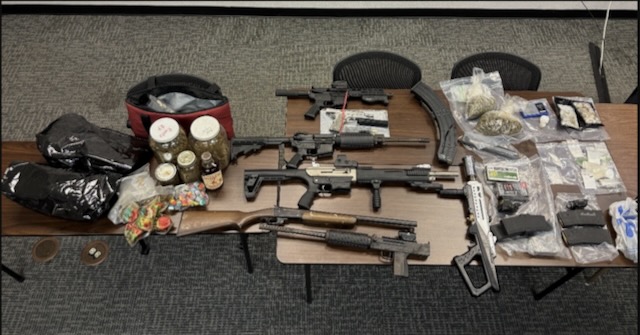
Photo of seized guns and drugs from people arrested in association with activities near Zilker Park’s “Barking Springs.” Photo from APD press release
The seized drugs were definitely significant in number, as was the shocking level of weaponry:
- “Six firearms and multiple rounds of ammunition
- Adjustable Propane Blow Torch Gun
- Approximately 9 pounds of Marijuana
- Approximately 51 Grams of Cocaine
- Approximately 20 Grams of Xanax
- Approximately 13 Grams of Methamphetamines
- Approximately 55 Grams Psylocibin
- Approximately 2 Grams LSD”
That’s a lot of drugs and a real variety. There’s something for everyone.
Also, as someone who was a teenager in the last half of the 1960s I can offer some advice to anyone who bought psychedelics and planned a day enjoying nature in Zilker Park: Go somewhere else. You don’t want to be tripping where there might be meth, cocaine, machine guns and maybe even a propane blow torch gun. Bad vibes, bummer, man.
Also, a note to APD, you spelled Psilocybin wrong.
The degree of criminality police found in Phase 1 of “Operation ‘Protect Our Parks’” is rather astounding; or at least it seems like that to me. Whether the bonds pass or fail City officials owe it to Austin residents, and visitors, to work harder to make parks and libraries safer places to visit.
And, if City officials are committed to adding more land to the Austin parks system they could start by reclaiming some of the land lost to homeless encampments. I know that there are many people among the homeless who are just down on their luck or have experienced devastating tragedies in their lives. But there is also a criminal and sometimes dangerous element associated with the homeless population — and a good amount of that is related to mental illness and drug addiction. Those are just facts. And City officials should at least be willing to admit this if they are going to ask citizens for more bond money for parks and libraries.
So voters face a tough choice on the two bond items near the bottom of their general election ballots. They have to choose whether the projects proposed for funding are important enough to grant more funds to a City government that has for years now been irresponsible with tax money and with City financial policies. And, they are being asked to expand parks and libraries, when both face serious unaddressed public safety issues.
Early voting begins Monday October 19.
* Correction: This story was edited to correct that the downtown Austin library is located near Shoal Creek, not Waller Creek. I apologize for the error and really knew that after 50 years here, but you couldn’t tell from this story. Daryl
* This was the second article in our series on the City of Austin portion of the November 3 ballot. Part 1 can be found here or on our home page. Coming soon will be articles on the five Council races and on proposed City Charter amendments.
_________________________
Folks: The Austin Independent is free to everyone who wants to read it, but it still takes money to publish and to research. So please chip in on our revamped Donate page and help us keep turning out stories. You will be hard pressed to find the kind of local journalism the Austin Independent provides anywhere else. If you happen to have difficulty on the Donate page please contact us here. Thank you.
The Austin Independent, a publication of The Austin Independent, LLC
All Rights Reserved