
Dang. They did it. Texas Democrats finally did it. They not only won a statewide race for the first time since 1994. They swept the board entirely, winning every statewide seat on the ballot; talk about a blue wave. Ted Cruz is now the only Texas Republican who holds statewide office. And it all happened in one night.
In a way this election brings to mind the now ancient term “Yellow Dog Democrat.” That saying dates back to the very old days when Texas was a one-party state and that one party was the Democrats. As I once heard Ann Richards explain it, the saying meant that voters would vote for the Democrat, even, if the party “put an old yellow dog on the ballot.”
Likewise, Texas Republicans, after three decades of one-party rule, thought a majority of Texas voters would vote for anyone they put on the ballot. Their yellow dog was Ken Paxton, a corrupt, impeached, philandering Attorney General who ran from the media and was even repeatedly lampooned for his appearance by the commander in chief to whom he had long pandered. This proved to be a step too far even in Texas.
Still, it took willing candidates and sound strategies to take advantage of the situation and that’s where James Talarico and Gina Hinojosa enter the picture.
Talarico clearly played the largest role in bringing about the Democratic sweep. First of all, he had the vision and foresight to see that the scandal-plagued Donald Trump ally Paxton would likely defeat incumbent John Cornyn in the Republican primary, but then be vulnerable in the general election. That’s exactly what happened.
Talarico had already established some statewide, and even national, political footing through social media posts about corruption and billionaire control at the legislature. That led to an appearance on Joe Rogan, where an impressed Rogan urged Talarico to run for President.
Talarico then gave up his safe seat in the Texas House, entered the Democratic Primary and defeated Congresswoman Jasmine Crockett, who jumped into the race after Talarico. During the primary Talarico survived a clearly manufactured race-based attack from Crockett, along with a blogger and also then former Congressman, now Congressman-elect again Colin Allred.
Meanwhile Paxton peaked when he defeated Cornyn in the March primary. He seemed to totally deflate and sometimes disappear after that. Talarico kept him off balance with a series of attacks, like accusing Paxton — with credible evidence — of voting in a precinct where he no longer lived, this being the Attorney General who was outspoken against voter fraud.

James Talarico on the campaign trail in 2026 – from his campaign Facebook page
Talarico also raised tons of money through mainly grassroots efforts and strategically he seemed to always be thinking at least three or four days ahead of opponents, and virtually everyone else. Ultimately, Talarico won going away. He became the first Texas Democrat to be elected to the US Senate since Lloyd Bentsen in 1988.
The Governor-elect
Then there is Governor-elect Gina Hinojosa who made her own calculations, giving up her safe seat in the Texas House and entering the governor’s race against three-term incumbent Greg Abbott. Hinojosa faced no significant opposition in the Democratic primary, but was considered a very long shot at best against Abbott. The governor was so confident of victory that, for example, he spent the days after the March primary attacking Talarico on social media, apparently trying to help right the Paxton ship. (I mean Paxton wasn’t going to do it.)
In the meantime Hinojosa was traveling around the state, beginning with a campaign launch last October in her native Brownsville. As Abbott continued to ignore her, Hinojosa outmaneuvered the governor on what turned out to be a key issue, data centers. Abbott was originally a strong supporter of data centers. In fact the whole Republican approach to data centers seems to have been to pander to the big money folks who wanted to build them and to ignore the mounting concerns of affected citizens — many in rural areas and small towns with a long history of voting Republican. Abbott was slow to grasp the situation, especially the growing anger, and even despair, of rural and small town Texans.
Finally, in August the governor took action. He ordered a halt to all data center electric grid approvals until the power demands of each data center were audited by ERCOT (the Electric Reliability Council of Texas). Then in September Abbott directed the Texas Commission on Environmental Quality (TCEQ) to stop all data center approvals until ERCOT completed its audit. After having been so supportive of data centers up to then, many evidently saw his actions as obviously political. It was too little, too late.
Abbott’s “Intimate and Embarrassing” Correspondence with Elon Musk
Then, on the first day of early voting, Hinojosa filed a lawsuit seeking correspondence between Abbott and trillionaire Elon Musk; correspondence the governor had previously blocked from release on the grounds that it was of an “intimate and embarrassing” nature. It might have occurred to a less over-confident governor that withholding documents on these grounds might itself be “embarrassing.” But, fearing no Democrat, Abbott evidently didn’t think of that; or the correspondence was so “intimate and embarrassing” that he was willing to take the chance on withholding the documents.
This was a hard hit from Hinojosa who charged in a press release accompanying the suit that Abbott had provided both “grants and tax breaks to Musk’s companies in Texas, including a $1.66 billion tax break shortly after Musk donated $500,000 to Abbott’s reelection campaign this year.”
The only defense, or offense, Abbott offered was to charge that Hinojosa was playing politics.
Hinojosa never got the documents, but her quest led to media examinations around the state. Those included a devastating piece by Brigid Grumet, the editorial page editor of the Austin American-Statesman. Grumet penned an article which examined how Republican control at all levels of state government, including the courts, led to a situation where the Governor could actually withhold documents based on the grounds that they were “intimate and embarrassing.”
As Grumet wrote,“Texans deserve to see these discussions, even if they are ‘intimate and embarrassing.’ Especially if they are.”
Then, to put things in context, Grumet explained, “Elon Musk’s companies have received more than $1.6 billion in state tax incentives, while mankind’s first trillionaire pushes for new laws, plans the world’s largest chip manufacturing plant in rural Grimes County, lobbies for a massive Tesla solar cell facility outside Houston — and apparently aims to acquire the popular public beach next to his South Texas Starbase.”
She added, “These are just the deals that we know about.”
Grumet also reported that last year, when “attorneys for Abbott and Musk fought the release of their communications” the “first step” in the process was the Attorney General’s Office i.e. Paxton’s office. The AG’s Office, continued Grumet, “sided with Abbott, allowing the heavy redaction of the records.”
Grumet then pointed out, “That decision came well before Musk poured $158 million this year toward the super PACs helping Paxton in his flagging U.S. Senate campaign.”
Election Night
Despite this skillful attack by Hinojosa, the accompanying exposure of seeming corruption, and the growing evidence that Talarico would defeat Paxton, it was still difficult to believe that Hinojosa could topple Abbott. This was the same governor who in 2014 trounced then Democratic phenom Wendy Davis by more than 20 percentage points. Then, in 2018 Abbott clobbered former Dallas County Sheriff Lupe Valdez of Dallas by 11 points. And, in 2022, he defeated a challenge from the popular Beto O’Rourke, also by 11 points, despite O’Rourke campaigning in all 254 Texas counties. (In contrast, here is a 2026 results map for the governor’s race.)
But, Tuesday night November 3, 2026 both Talarico and Hinojosa — and all Democrats in statewide races — took an early lead. Initial numbers, however, are dominated by reporting of the early vote in major urban areas (although Austin’s came later). So Hinojosa’s percentage was expected to decline as more rural returns came in. On the other hand Talarico had been pulling away from Paxton in the polls and so it was no longer a surprise that it looked like he was going to win, but Hinojosa’s victory still seemed far from assured.
Then shortly before 10 PM, Abbott appeared on TV with his family and supporters gathered behind him. After saying that serving as governor had been “the joy of my life,” Abbott then thanked his wife and daughter, briefly praised his supporters then suddenly, without a segue, said, “I also want you to know that before coming up here right now, after looking at all the details of every county in the entire state, I made the decision to go ahead and call Gina Hinojosa and congratulate her on winning this race for governor of the state of Texas.”
I made the decision to go ahead and call Gina Hinojosa and congratulate her on winning this race for governor of the state of Texas.”
Governor greg abbott around 10 pm on tuesday november 3, 2026
With that it was clear that a political earthquake had indeed occurred. Honking horns blared throughout downtown Austin and likely throughout the City. Howls of celebration rang out.
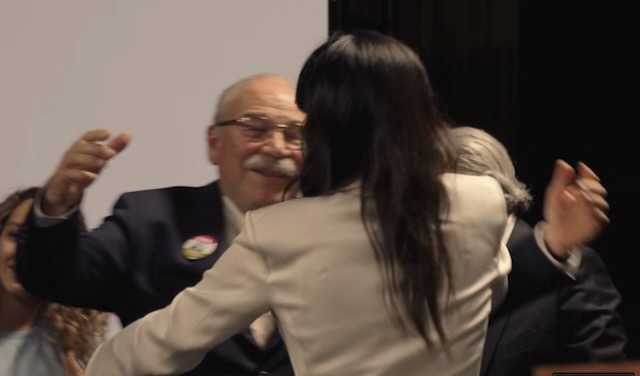
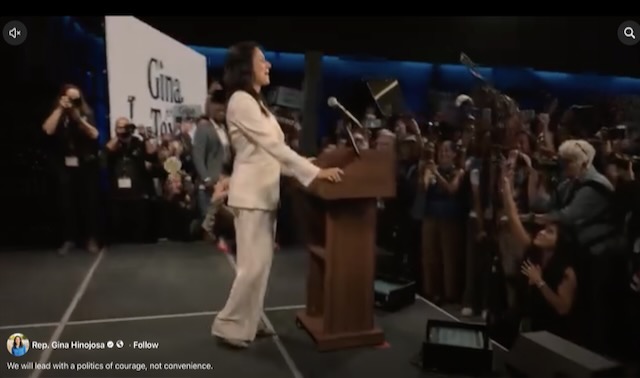
Gina Hinojosa and her father Gilbert Hinojosa, former head of the Texas Democratic Party, on election night 2026 – From Hinojosa campaign Facebook page, as is photo at top of Gina Hinojosa greeting the crowd at her victory party
Within a hour or so it was clear that, incredibly, Democrats were likely to win every statewide seat. That included Austin State Representative Vicki Goodwin who sent the often vicious Lieutenant Governor Dan Patrick packing. Goodwin first made it to the legislature in 2018 by defeating the notorious Austin-basher Paul Workman.
Also, Austin State Senator Sarah Eckhardt was elected State Comptroller. This is her latest step up, going from Travis County Commissioner to County Judge to State Senator and now State Comptroller. Eckhardt made clear during her campaign that she will arrive at the Comptroller’s Office with plans to strengthen and remake the office and restore some functions cut by Republicans.
Abbott Did the Right Thing
Before we move on, let’s note that Abbott’s concession was an admirable thing to do. It is something that used to be expected in American politics until Donald Trump lost in 2020. By coming out early and conceding the race Abbott made it clear that he would not be taking the Trump approach and that he would honor an important American democratic tradition.
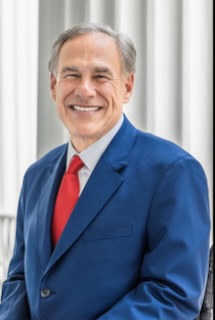
Departing Texas Governor Greg Abbott – official state photograph
Whether because Abbott conceded, or who knows why, a few hours later President Donald Trump attacked the governor on Truth Social. Trump posted, “If Greg Abbott, the Governor of Texas, hadn’t become a RINO in the last six months of his Political Life, he wouldn’t have lost.” RINO stands for “Republican In Name Only.” Of course Trump offered no evidence for his reproach of Abbott. This was perhaps Trump’s thanks for Abbott’s long years of alliance with the president. That most famously included Abbott’s very effective political strategy of busing undocumented immigrants to major cities — which had declared themselves sanctuary cities. The huge influxes led to a variety of problems and discontent in several Democratic-run cities. This strategy was widely credited with helping Trump in his successful 2024 campaign.
Abbott may not have expected any thanks. By then, it should have been obvious to anyone allying with Trump that their eventual fate would be to be discarded or, more likely, be blamed for some political and/or policy disaster brought on mainly by Trump himself. In any case Abbott is not a RINO.
Talarico and Hinojosa Stake Out Similar Economic Approaches
Both Talarico and Hinojosa weathered weeks of saturation negative advertising that painted them as far left radicals. Talarico in particular provided Republicans with some juicy material. There was a 2020 tweet in which he said that “me and every other white American” are “contagious” with a “virus,” and “we spread it everywhere we go.” Then there was a 2020 forum where he called for the “dismantling” of capitalism. Early on Republicans also tried to paint the devout Christian Talarico as practicing a radical form of Christianity. But, that went nowhere. Rather than being harmed by these past political positions, Talarico was able to successfully abandon them and campaign as a centrist who perhaps got carried away a few times in the past.
But, there was more to it all than that. Talarico charted an economic message that wasn’t new by any means, but he was able to frame it in a way that succeeded where others have not. Talarico repeated in his victory speech a formulation that he expressed throughout the campaign: “The billionaires who own the social media algorithms, who own the cable new networks, who own the politicians fighting on our screens, they want us at each others throats. They want us focused on how we’re different instead of on how we’re the same. They want us looking left and right at each other instead of up at them. The real fight in this country is not left versus right. It is top versus bottom.”
Hinojosa likewise, in her own way, took a unity approach based largely on economics. Like Talarico, Hinojosa stressed that she would work to represent all Texans, not just those who voted for her. Hinojosa also vowed not to tolerate any corruption in her own party: “No looking the other way when someone in my own party does wrong. No excuses for corruption because it comes from someone who shares my politics. Corruption does not become right when our side does it.”
Staking out ground where Talarico did not go, Hinojosa repeatedly stressed during the campaign that she would not fight “culture wars,” a break from party orthodoxy, at the very least a break from the far left reaches of the party. She coupled this with calling herself an “economic populist,” as opposed to a “progressive.”
During the campaign Hinojosa also offered a term to describe her political and economic approach: “economic populism.” She specifically resisted being labeled a “progressive.”
This led to New York Times reporter Lulu Garcia-Navarro challenging Hinojosa’s choice of terms during an interview, posted on October 24. The interview also serves as a counterweight to anyone who might be tempted to think that Hinojosa is a lightweight “progressive” who accidentally ran for governor at just the right moment. Instead she is a well read, thoughtful state legislator who clearly distinguishes herself from the far left of her party.
In a videotaped interview Garcia-Navarro repeatedly challenged Hinojosa over labeling herself an “economic populist,” or, as Garcia-Navarro put it, “seeing yourself as a ‘populist’ and not a liberal or a progressive.” She pointed out Hinojosa’s record in the House is mostly liberal and asked, “Tell me why you’ve landed on ‘populist’ as a label for yourself now.”
Hinojosa replied, “I think ‘populist’ meets the moment of our time. Again, (there is) one fight in this country and it is about economic power, and populism is about economic power. I think that whereas in the past we evaluated power as right versus left, I just don’t think that those labels apply at this moment in history, not at this moment in political history. We see that things are so stacked against working people in this country and so, listen, it’s just a label, but if I were to pick a label to describe ‘what are my politics’ it is ‘economic populism.’”
As Garcia-Navarro fretted over this, Hinojosa continued, explaining that economic populism “is rooted in our (Texas) history.” As an example she cited Lyndon Johnson’s grandfather “who organized farmers against big railroads that were taking advantage of them.” She continued, “In much the same way we have working Texans who are up against tech giants, big tech. So I chose this title to define what is my politics because I do think that this has to be the politics of the moment to meet the challenges of the moment.”
Undeterred, the Times reporter said that Hinojosa then must be a “progressive populist.”
Hinojosa immediately rejected this categorization: “Look, I just think that progressive politics is associated with culture wars. And, I have no interest in fighting culture wars at this time. Fighting culture wars at this time is not a winnable fight. It is the fight that divides us . . . And that is not the fight of 2026.”
“I just think that progressive politics is associated with culture wars. And, I have no interest in fighting culture wars at this time.”
Texas Governor-Elect gina hinojosa
Refusing to give up, Garcia-Navarro then argued that progressivism means more than culture wars, it could also describe one’s approach to taxation or health care.
Hinojosa shot back, “It may mean more than that to you, but I think to a lot of people it means the culture war fights because those are the fights that we’ve been fighting for the last ten years.”
Garcia-Navarro then, rather smugly, claimed that this just proved an earlier assertion of her own, that Hinojosa is just using the populist label because the term progressive is “toxic.”
Hinojosa rapidly fired back, “No, it’s not that. It comes back to it doesn’t meet the political moment of our time. It is not what 2026 is about. Look, we are facing an almost existential crisis in this country because tech giants are having their way with us. Look, there is one fight, and we are so caught up in fighting each other in a divided nation, fighting each other over ways that we disagree about social issues and culture wars, that we are all about to lose. And, so I am not going to perpetuate that anymore.”
If Governor Hinojosa can stick with this approach in office as stubbornly and steadily as she did with the New York Times reporter it could mark a huge policy and ideological advance for Democrats. On the other hand “culture wars” is not a totally precise term. It’s not totally clear what all Hinojosa includes in that, but that will become more apparent.
In any case, the economic approach advocated by both Hinojosa and Talarico is consistent with that of Reverend William Barbour in his book White Poverty, although I do not know if either Hinojosa or Talarico have read the book or followed Barbour in other venues. Barbour, who is Black, repeatedly advocates for organizing across racial lines to attack poverty in all communities. Up to this point that has not been the approach of most Democrats, who tend to base most everything on race. Democrats as a whole have also been ineffective, at best, as the distribution of wealth widened to Gilded Age levels over the last forty-plus years.
While only time will tell exactly what Hinojosa means by “not fighting the culture wars, her approach is clearly different than, even opposite of, that which prevailed once again in Austin City Council and City Charter amendments. Our next story, coming quick on the heels of this one, will report and analyze those results.
_______________________
Folks: The Austin Independent is free to everyone who wants to read it, but it still takes money to publish and to research. You will be very hard pressed to find the kind of local journalism that the Austin Independent provides anywhere else. So please chip in on our Donate page and help us keep turning out stories.
If you happen to have difficulty on the Donate page please contact us here. Thank you.
The Austin Independent, a publication of The Austin Independent, LLC
All Rights Reserved