
Down toward the bottom of their November ballots Austin voters will find eight proposed changes to the City Charter. Seven of those propositions were placed on the ballot by the City Council and City staff. Only one Charter change proposition made it to the ballot through a citizen petition. That is Prop I, as in the letter i, not the number one. This article is about Prop I, the citizen petition item. We cover the rest of the propositions in a different article.
Prop I would require a comprehensive audit of all City finances every five years, with the results available to the public. It requires the City to get an audit team under contract within 120 days after passage of the proposition, that is if it does pass. The contractors would be chosen by the City Auditor after a procurement process.
The petition drive was originated and led by Save Austin Now, a group led by former Travis County Republican Party Chair Matt Mackowiak. I realize the Republican affiliation immediately makes the matter suspicious with a wide swath of Austinites. The group has always, however, portrayed itself as nonpartisan and has indeed historically featured Democratic co-chairs. In the current battle a leading spokesperson for Prop I is former Democratic County Judge Bill Aleshire, who now identifies as a political independent.
A few years ago Save Austin Now won majority support for an item they got on the ballot through a petition drive. That was the May 2021 reinstatement of the so called camping ban, by a 57% to 43% margin. That Save Austin Now campaign was in response to a 2019 Council action in which a Council supermajority repealed the longstanding “camping ban.” The 2019 repeal by Council was led by then Council Member/now Congressman Greg Casar and then Council Member/now County Attorney Delia Garza. The Casar-Garza-led Council action allowed homeless people to camp in virtually any public space and that’s what happened, especially in City parks, open spaces near residential neighborhoods and on downtown sidewalks, particularly near City Hall.
The Save Austin Now ban repealed the Council action. It won even in many heavily Democratic precincts in the central city. Casar’s and Garza’s roles in this saga did not hurt them politically. Austin voters instead elevated them to their current positions, Garza in 2020 and Casar in 2022.
Save Austin Now quickly followed their camping ban victory with another petition effort — this one to require 2 police officers for every thousand Austin residents. That went to voters in November 2021. Voters determined that Save Austin Now had gone too far this time. The proposition was rejected by a more that two-to-one margin. It was widely considered too costly — permanently costly; and it also limited the budgetary power of elected officials in the future. So Save Austin Now’s record on citizen initiatives is one win and one loss.
The group was also part of a broader coalition that defeated Prop Q last year — with many groups and individuals working separately from Save Austin Now and some saying so publicly. The effort that became Prop I is at least in part a follow-up to the campaign against Prop Q, in that it aims at what backers of Prop I consider wasteful and reckless spending by the City Council and a lack of oversight of that spending.
After the Prop Q defeat Mayor Kirk Watson acknowledged that the City needed to restore trust. Mackowiak was also already, talking about an audit in the wake of the election. Hoping to head off the Save Austin Now initiative Watson persuaded the Council to hire a firm to conduct an independent audit. This was done through passing an ordinance called, the “Comprehensive Efficiency Assessment Program.” The contractor was hired very recently. Watson argued that putting the audit requirement in the City’s governing document, the City Charter, was unnecessary and too permanent.
Mackowiak moved forward anyway, arguing that an audit requirement established by ordinance could be too easily undone or interfered with. Both Mackowiak and Aleshire have said that the contractor the City has already hired could conceivably be used on a Prop I audit, as long as procurement requirements are followed.
So Prop I is going to be sort of a quiet, polite item – debated mainly in financial terms and on whether the City Charter is the appropriate place for such a requirement.
Just kidding.
“Don’t DOGE Our Austin” Rally
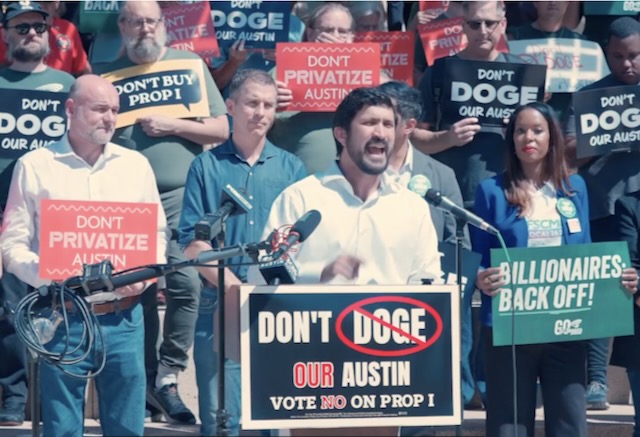
Opponents of Prop I, including a majority of the City Council — six members — gathered on the steps of City Hall on October 7 for a raucous opposition rally with the theme “Don’t DOGE Our Austin.” That’s DOGE, as in the Trump Administration’s short-lived, but chaos-inducing, jobs-slashing Department of Government Efficiency — which was led by Elon Musk.
A crowd that included six City Council Members (a majority), union leaders and Congressman Greg Casar (at top), filled most of the steps outside City Hall. They warmed by chanting “Don’t DOGE Our Austin” and “Don’t Buy Prop I,” while holding signs reading “Don’t DOGE Our Austin,” “Don’t Privatize Austin” and “Billionaires Back Off!”
The event was MC’d by local AFCME Vice-President Cynthia Simons. Simons set the tone by announcing,“We are here today to tell you that workers are once again under attack.” She continued, “The threat is Prop I, a right wing effort designed to cut the City’s budget, reduce our workforce and move decision making for how Austin is run away from our democratic process and into the hands of greedy consultants.”
Simons then quickly invoked Save Austin Now and Mack Mackowiak. “They have infected our City,” Simons said.
Another early speaker was Louis Malfaro, Executive Director of the Travis County Democratic Party. “I’m here to let you know Democrats are against Prop I,” said Malfaro. He added, “This is an attack on City services masquerading as a good government initiative.”
“I’m here to let you know Democrats are against Prop I.”
Louis Malfaro, Executive Director of the Travis County Democratic Party
Malfaro concluded, “We have a message for Democrats in Travis County. Get out there and vote no on Prop. I.”
Council Member Vanessa Fuentes was next up. She began by introducing her five colleagues in attendance. Visible on camera, right behind the microphone, and helping lead chants of “Don’t Doge Our Austin,” were Mayor Pro Tem Chito Vela, Council Member Mike Siegel, and Council Member Zo Qadri. Next to Qadri was Amber Goodwin, the “progressive” chosen one to replace Natasha Harper Madison in District 1; and until very recently an Assistant Travis County District Attorney under José Garza. Fuentes also introduced Council Members José Velasquez and Ryan Alter who were further down the row and out of the camera shot.

Fuentes then said Prop I is “just a local version of DOGE,” teeing the topic up for Congressman Greg Casar who spoke shortly afterward.
Fuentes added, “One of the many reasons that I oppose Prop I is that it is just another corporate consultant giveaway — leading this reporter to wonder what are all the other corporate giveaways that Fuentes lumps in that category, and how many of those she voted to fund.
And Fuentes hammered what could be an effective argument against Prop I, that it would require the auditors to propose enough in savings to pay their own fee. Fuentes called that “an inherent conflict of interest.”
Casar then drove home the DOGE message, but first offered a distinction between the two sides. “I am a proud AFSCME member and I‘m also proud to represent this city in the US Congress because I love Austin. And, I’m asking every voter watching to vote no on Prop I because the people behind it (Prop I) hate Austin.”
“I‘m also proud to represent this city in the US Congress because I love Austin. And, I’m asking every voter watching to vote no on Prop I because the people behind it (Prop I) hate Austin.”
congressman Greg Casar
Casar continued,“Prop I would be Austin’s own version of Elon Musk’s DOGE.” The crowd booed loudly.
The Congressman continued, “I was serving in Washington D.C. when Elon Musk started DOGE,” smoothly working in the name of the villain Musk. “I watched first hand what happened. First, hundreds of thousands of hard working public servants were pushed out.” Casar went on to cite several other examples of DOGE cuts and layoffs.
As the author, I’m going to step in here and say that I personally agree with some of Casar’s criticisms of DOGE, especially the one about federal employees being pushed out. Musk had no respect for, or understanding of, what these employees did, nor any understanding of the services they provided the nation. Yet he destroyed their careers and eliminated the services they provided anyway, based on arrogant assumptions by him. The chainsaw that he displayed at a conservative rally during that period was a very accurate symbol of his approach. The same was true of many of DOGE’s cuts to foreign aid. So, I agree with Greg Casar that DOGE was damaging to the country and to the personal lives of many people who did not deserve the punishment.
How DOGE and Prop I Are Different
The problem with Casar’s statement is that he did not provide any examples of how Prop I resembles, or would resemble, DOGE. The two sentences that I quote above from Casar were said back to back. There was nothing in between them. He first claimed that Prop I would be “Austin’s own version of Elon Musk’s DOGE.” Then he went straight into a long list of examples about how horrible the actual DOGE was. Casar did not say one thing explaining how Prop I equates to DOGE; and neither did any other speaker at the rally. The Congressman just stated it as a fact..
The “Don’t DOGE Austin” website doesn’t offer any specifics either (at least at press time) on how Prop I will be an Austin version of DOGE. Instead it just repeats a few points from the press conference. The only link on the home page is to the donation page.
The problem with Casar’s statement is that he did not provide any examples of how Prop I resembles, or would resemble, DOGE.
Here are a few differences between DOGE and Prop I.
In DOGE Elon Musk was actually granted the power to make the cuts he did, although there are certainly legal disputes over exactly what his authority was.
In contrast, the consultants/auditors who would perform Prop I would not have the power to make any cuts whatsoever. Instead they would identify alleged waste and potential spending cuts and/or suggest ways City operations could be done more efficiently and perhaps with less cost. They could recommend cutting some jobs. None of the consultant recommendations, however, would automatically go into effect. Instead the auditors’/consultants’ recommendations would be forwarded to City Management and the City Council — and be released to the public.
Then the City Council would decide which cuts to make or not to make — likely with some recommendations from City staff. No job cuts or financial cuts could be made without a majority vote of the Council.
In reality, the stakes may be high, but any process resulting from an approval of Prop I would ultimately be very similar to many other items that appear on an Austin City Council agenda.
Those in favor of the cuts will show up at the Council Chamber and speak in favor. Those who oppose the cuts will marshal their forces as well. Then the Council will vote. And, when elections come around each side will try to pin the votes for or against the proposed cuts on the Council Members who voted differently than they wanted. It will just be another Austin political fight. And then Council will go on to the next item.
So there might be other potential concerns with Prop I that deserve more public discussion. Watson’s stance against putting an audit into the City Charter, for example, is a valid issue for serious discussion. Also, a requirement that an election to increase property taxes beyond the state limit can only be held within a year after an audit would restrict the Council’s power to call such an election; and keep in mind this would be an election where the voters have the final say. That seems to deserve more discussion, and there are likely other matters that might merit more discussion as well.
So far, however, opponents and Council Members are sticking solely with the DOGE analogy.
Does This Sound Familiar?
The “Don’t DOGE My Austin” strategy is remarkably similar to the pro-Prop Q strategy last year. There, the backers tried to say that Prop Q was needed to “restore Trump cuts to Austin and prevent catastrophic cuts to firefighters, EMS, parks, pools, libraries, meals on wheels, emergency shelters, domestic violence prevention, and more.” The campaign website featured disembodied heads of Donald Trump and Greg Abbott.
The whole idea was to convince Austin voters that voting for Prop Q was a way to fight back against Donald Trump, MAGA and Trump’s administration. But, when asked to name the Trump cuts that Prop Q would restore, no Council Member would name any and City staff hid from view — obviously to avoid having to give accurate answers and thus contradict Council Members’ campaign claims.
Almost exactly the same strategy is being pursued against Prop. I, with Elon Musk being the principal MAGA villain. It doesn’t help Prop I backers that Musk was recently in the news for funneling money to a PAC that is supporting Republican Senate Candidate Ken Paxton, against James Talarico. But, like DOGE, Musk’s activities in the Senate race have no impact on Prop I.
Don’t Scrutinize Us – Look Over There
Also worth mentioning is that the vocal opposition to Prop I by six Council Members puts them in the position of opposing something that would scrutinize them. I mean arguing against putting the item in the Charter would be understandable and maybe even dignified. But, and call me old fashioned, it’s particularly weird for them to be out on the City Hall steps chanting slogans against an initiative designed to scrutinize their spending of public money.
For instance Council Member Chito Vela held a “Don’t Privatize Austin” sign during the rally. That implies that Prop I would give someone other than the Council the power to start privatizing City services. But, nothing could be privatized without going to Vela and the rest of the Council. Also, the Council could set policies restricting or setting criteria for what can or cannot be brought before the Council to consider privatizing. But, there Vela was, holding a “Don’t Privatize Austin” sign and chanting “Don’t DOGE Our Austin.”
It’s also interesting to know that José Velasquez attended the rally. His appearance was part of a dizzying series of moves seemingly related to his bid for reelection. First, in May, Velasquez voted in favor of changing City financial policies in a way that made having a bond election this year compliant with the City’s financial policies. Two months later, when it was time to set the election, Velasquez broke ranks with his “progressive” colleagues and joined Mayor Kirk Watson and Council Member Marc Duchen in voting against having a bond election this year. He said his vote was “about recognizing that our (District 3) residents are already carrying enough.”
A few weeks later he was at the anti-Prop I rally, opposing an initiative designed to find savings for the taxpayers Velasquez was allegedly empathizing with a few days earlier.
And, the Save Austin Now Campaign
With the space we have left, let’s look in on the Save Austin Now campaign, those alleged haters of Austin. They seem to be taking a rather calm, information providing approach. For instance their website provides bullet dots listing aspects of the proposal. And, they also provide links to read the ballot language or the full petition.
Here are a few of their bullet dots on what the audit and review would include:
- “Competitive selection of a qualified independent contractor by the City Auditor within 120 days after passage.
- First review completed within one year of engagement, followed by completion every five years.
- Analysis of affordability, performance, staffing, contractors, spending, controls, and Texas peer comparisons.
- A contractual commitment to identify savings exceeding the contractor’s fee.
- A recent completed review before an election to raise the City’s maintenance-and-operation property tax.”
Then, there’s a section called “Follow the whole dollar,” which lists some tasks a contractor would be required to perform:
- “Benchmark City-related costs of living and affordability.
- Develop workload, cost, and outcome measures for offices and contractors.
- Use forensic accounting to examine financial controls.
- Compare Austin’s operations and programs with Texas peers.
- Make specified drafts and gathered information available to the public on request.”
The only part of the SAN website that could be considered negative campaigning is a section titled: “Five stories that explain why Austin voters stopped trusting City Hall with their money.” And on these they provide links to reports by the City Auditor and to news stories backing their claims. For instance there is:
- A six years-long fraud by an employee at Austin Energy who made up the names of vendors and pocketed the money that was supposedly going to those vendors. The total bilked was $980,000 in a scam eventually discovered by City auditors;
- The million dollar plus paid to consultants in the famous logo and branding saga;
- “About 150 solo lunches charged to a City credit card;”
- In a “sample of 28 consultant contracts, staff could not supply a formal needs assessment for 11. Supporting evidence for deliverables was missing in six;” and
- A “performance review (which) covered 25 contracts worth about $30 million” on which “67 of 151 annual performance expectations were missed.” Additionally, only “Six contracts met all their annual expectations.”
In what will likely be surprising to some, Save Austin Now offers cautioning caveats along with the above bullets. This is done in a way apparently intended to keep readers from exaggerating what Save Austin Now is claiming; a caution against leaping to conclusions, if you will.
For instance along with the bullet on missed “performance expectations” there is a note that reads:
“What the figure means: It describes expectations, not the share of funding wasted. The report also documents City-process problems and provider challenges; its findings do not represent all nonprofit contracts.”
What’s Happening?
OK. What’s going on here? Is this some sort of Republican plot to act calm and reasonable in an attempt to trick people into voting for an audit of City’s finances?
Maybe.
But, perhaps the strategies are dictated by the situation. Here’s what I mean.
Everyone knows this is Austin and that Austin is heavily Democratic and that there’s going to be a huge Democrat turnout in the upcoming election. Knowing this, the members of the Travis County Democratic establishment are trying to herd as many Democrats as possible into the anti-Prop I camp — urging them to vote no on a measure that would provide financial scrutiny to an all Democratic body. They evidently don’t see any need to offer any specific reasons to vote no, beyond making a false Trump-Musk-DOGE analogy.
Their message is what Travis County Democratic Executive Director Louis Malfaro said at the rally, “I’m here to let you know Democrats are against Prop I,” which could be interpreted to mean that you aren’t really a Democrat if you vote for Prop I.
Meanwhile Save Austin Now knows they need to persuade voters to break ranks and support the audit. They know that to have a chance they must persuade some Democrats to back the audit. They also need to convince a sizable share of independents — who do exist in Austin — to vote in favor of Prop I. And, Save Austin Now evidently realizes that negative attacks on Council Members, the City, or other City officials would likely backfire and just make them look more Republican.
Maybe it’s some sort of calming effect that results from going through a process of forming a nonpartisan coalition. (I mean, who around here would know?) Maybe it’s that they have an actual auditor on the team. That would be former Travis County Auditor Susan Spataro.
Whatever the reasons, Save Austin Now is running a campaign based on convincing voters of the merits of their position. Meanwhile, a Council majority and union and Democratic party leadership are urging a no vote by maintaining that Prop I is “just a local version of DOGE.”
Save Austin Now Football Movie
Save Austin Now even produced their own football movie called “Friday Night Lights In Austin.” Let’s take a look.
It begins with an announcer saying, “Tonight the undefeated, unaudited ‘City Hall’ takes on the ‘”‘Austin Taxpayers.’” It then shows a City Hall pass rusher make a clearly late and dirty hit on the Austin Taxpayers’ quarterback. The camera pans to a referee who rules, “clean hit.”
Soon, it’s halftime and the Taxpayers head to the locker room for an inspirational speech from their coach — who at least in the movie is not Matt Mackowiak. The half time inspirational features review of some media reports on City Hall spending — and Mackowiak does give a short statement in what could be interpreted as a cameo appearance. Then the coach writes a play on the board which, “will save Austin, right now.” It reads, “Prop I.”
Then the second half begins and players from the Austin Taxpayers list the five key “rules” of the audit, similar to what we listed above. A flag should have been thrown, however, on the claim that City Hall implemented the proposed tax in Prop Q even though voters turned it down.
Next, two men in sports coats and khakis — apparently auditors — don helmets and comically take the field. The announcer soon proclaims “Austin has flipped this game upside down and is now on the one yard line, on the verge of exposing the machine.”
A City Hall player on the sideline then beseeches a ref to call a penalty. The ref ignores him. As the Austin Taxpayers line up on the one yard line their quarterback turns to the camera and urges people to vote for Prop I.
Then the ball is snapped and the commercial ends . . . leaving the end to be determined on election day.
And that is indeed when the game, or the election, will be decided. On Prop I, as with the two bond items I wrote about last week, voters (at least the ones doing their own research) are put in a tough, agonizing situation. Most will be voting Democratic. So there is a pull to vote the way that Democratic elected officials are recommending. At the same time, even many Democrats have probably discerned a pattern of wasteful and reckless spending at City Hall — along with a lack of results. If Democrats have noticed such a pattern then independent voters — likely have too.
So, as in the football ad, the outcome won’t be known until election day.
____________________________
Folks: The Austin Independent is free to everyone who wants to read it, but it still takes money to publish and to research. You will be very hard pressed to find the kind of local journalism that the Austin Independent provides anywhere else. So please chip in on our Donate page and help us keep turning out stories.
If you happen to have difficulty on the Donate page please contact us here. Thank you.
The Austin Independent, a publication of The Austin Independent, LLC
All Rights Reserved