
There are a lot of different opinions and philosophies on how to approach Austin’s homelessness problem. One thing it seems we should be able to agree on though is the need for a solid estimate of how many people are homeless in Austin and Travis County, or experiencing homelessness in Austin and Travis County. But, that is not happening.
First of all, the City has no official count, or at least not one they are willing to share publicly. The City’s Homeless Strategies and Operations Department (HSO) is charged with implementing the official “Austin Action Plan to End Homelessness:” So it seems like they might have a number for the current situation, just so they can know how far they have to go; and to maybe help them figure out how to get there. So we asked, “What does the City believe is the current number of people experiencing homelessness in Austin (and Travis County), and please specify sheltered and unsheltered?”
Here I need to pause and insert a note. We addressed our questions to the City’s HSO Director David Gray. And, given that the questions were primarily about numbers, we asked that Gray reply in writing. Gray did not reply directly. Instead a department “spokesperson” replied, beginning with: “Please attribute the following responses to City of Austin Homeless Strategies & Operations Spokesperson.”
In response to the question on what does the City believe the current number of homeless people is, the spokesperson cited the 2025 “Point-In-Time Count” which is administered by ECHO (Ending Community Homelessness Coalition), the lead nonprofit for the City on homelessness services. The spokesperson wrote, “The 2025 Point-in-Time count identified 3,238 persons experiencing homelessness on the nights of January 25-26, 2025. 1,577 persons were identified as unsheltered, 1,661 persons were identified as sheltered. The next Point-in-Time count is scheduled for January of 2027.” The PIT Count, by the way, is the lowest estimate available.
Even ECHO notes in its 2024 “snapshot,” that the PIT Count is not the best measure. As they explain, “While the biennial Point in Time (PIT) count is the most well-known snapshot estimate of homelessness, methodology can be different year to year. The monthly data used here [in the “snapshot”] is based instead on a more reliable, repeatable methodology developed by our Research & Development Team.”
But, when asked for an official City estimate of the number of homeless people in town, the Department “spokesperson” pointed to the less “reliable” count with the inconsistent “methodology” — but the one with the lower number.
Now, let’s take a look at ECHO’s 2024 “snapshot.” They liken it to “I-35,” in that “a snapshot tells us how many cars are on the highway at a moment in time.” Extrapolating this to a “snapshot” of Austin’s homeless population, they reported: “We (ECHO) estimate at least 6,235 people experienced homelessness in Austin or Travis County on a single day in May 2024.” ECHO went on to estimate that 5,020 people were “unsheltered” and 1,215 were “sheltered.” They define “unsheltered” as people “sleeping in tents, cars, abandoned buildings, and other places not meant to live in.” Sheltered was defined as “staying in emergency shelters or transitional housing.”
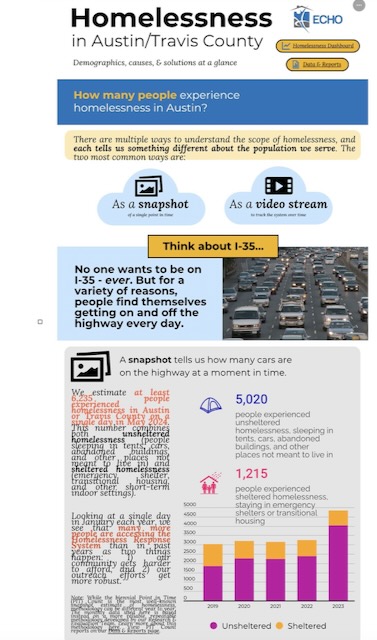
Screenshot of ECHO’s 2024 “snapshot.” Chart at top by Daryl Slusher
To make matters more complicated the “database” portion of ECHO’s current website reports that the number of people experiencing homelessness in Austin is 3,865 “People Likely Experiencing Unsheltered Homelessness” and 1,070 “People Likely Experiencing Sheltered Homelessness.” That is a total of 4,935. On the website ECHO doesn’t provide a source or methodology for this number. So, to someone perusing the website, it could mean a 20% drop from their 2024 “snapshot” number or a 52% rise from the 2025/most recent PIT count; or it could be something else entirely.
A spokesperson for ECHO explained, “The total on our dashboard is based on administrative data from the Homeless Management Information System (HMIS), a person-level database that providers use to track services and housing options for folks. . . The dashboard estimate is a snapshot of a point in time, like the PIT Count, rather than the rolling video we’re tracking in HMIS day to day. But because the methodologies are so different, the PIT Count and the dashboard are not comparable numbers. Instead, each of these measures tells us different things about the population, and we use this variety of sources and data to work toward the most effective Homelessness Response System we can build.”
Any Given Night
Meanwhile HSO Director David Gray doesn’t appear to go by the PIT Count cited as the City’s official estimate by his Department. For instance, in August 2025 Gray told Fox7 News, “We’re a pretty large city geographically. Across those 300 squares of miles on any given night, we have 6,500 people experiencing unsheltered homelessness.” Note that Gray said the 6,500 number was “unsheltered” homeless people. So he must think the total number is even higher than 6,500.
On any given night, we have 6,500 people experiencing unsheltered homelessness.”
David Gray – Director austin homeless strategies and operations department
Gray was perhaps basing his statement on ECHO’s 2024 “snapshot,” but that is not clear.
A Number to Consider
I ran across a higher number that seems less ephemeral and more grounded in solid data. That is a figure reported by Central Health in their 2024 annual report. Therein they write, “In 2024, 11,225 people experiencing homelessness were enrolled in Central Health coverage plans, including MAP (Medical Access Program), MAP Basic, and CHAP (Central Health Assistance Program).” In response to emailed questions Central Health wrote, “Yes, to confirm, the 11,225 figure represents unique individuals enrolled in Central Health coverage plans (MAP, MAP Basic, and CHAP) in 2024.” They also offered this qualifier: “As an important point of clarification, please note that these enrollees self-report their housing status at the time of enrollment.”
This is for the same year that ECHO’s snapshot estimated “6,235 people experienced homelessness in Austin or Travis County on a single day in May 2024.” And it’s for a period that ends just before ECHO’s 2025 PIT Count, which found “3,238 persons experiencing homelessness.”
“In 2024, 11,225 people experiencing homelessness were enrolled in Central Health coverage plans, including MAP (Medical Access Program), MAP Basic, and CHAP (Central Health Assistance Program).”
From Central Health 2024 annual report
Those are significant differences. And both numbers covered Austin and Travis County.
First let’s note — although we have not examined the program in detail — it appears that Central Health is carrying out an important and even noble function in providing health care to so many people who are experiencing homelessness.
Back to the numbers, we asked the City HSO to “please explain the difference in these two numbers (ECHO’s “snapshot” and the Central Health number about individual homeless people who accessed health care programs).” And, we inquired whether the Central Health number indicated “that there are thousands more people experiencing homelessness in Austin than the City and ECHO are reporting?”
The HSO spokesperson answered, “Please reach out to ECHO for clarification on their methodology and the criteria utilized for the calculation of figures. Different entities report varying numbers of people experiencing homelessness because of distinct definitions, timing, methodologies, and geographic focus.” The spokesperson then shifted to explaining the PIT Count, which we had not inquired about.
There is one important difference between the Central Health figure and the ECHO snapshot and PIT Count numbers. The Central Health figure might include some people who found housing during the year (are no longer homeless), possibly through City programs. That is, some people may have gotten out of homelessness after applying for the program.
David Gray, for instance, in an October 10, 2025 press release maintained, “More than 3,000 people moved into housing last year with support from community partners.” Gray did not provide, however, any numbers for people who became homeless during the year or who were homeless and moved to Austin. We asked the HSO for these numbers, but they did not provide them.
The absent numbers are important — among other reasons — so that it can be determined if the City, and ECHO, are making any progress on their goal of ending homelessness in Austin. And, if they are not reducing the numbers, then it seems perhaps a little selective to just highlight the number of people that were “moved into housing;” and then refuse to answer questions about:
- “the estimated number of people experiencing homelessness before “3,000 people moved into housing;”
- the “estimated number for how many people became newly homeless in Austin that year;” and
- “and how many homeless people moved to Austin that year?”
Also, one might expect the Central Health number to decline if 3,000 homeless people “moved into housing.” But, that was not the case. Central Health’s number for 2025 increased to 11,392.
One might expect the Central Health number to decline if 3,000 homeless people “moved into housing.” But, that was not the case. Central Health’s number for 2025 increased to 11,392.
The Austin Independent did not have the 2025 Central Health number at the time we sent our questions to the City HSO. If we had had that number at that time we would have asked some questions about it.
A Central Health representative explained that the agency highlights something different each year in their annual report and that’s why the number of people experiencing homelessness was not repeated in their 2025 report. But he added, “we think including this number year-over-year is a great idea. For future Annual Report cycles, we are looking at making this statistic a consistent feature by adding it to our ‘By the Numbers’ section, which appears in every annual report.” If Central Health proceeds in that manner it could contribute to obtaining a more solid number, if City officials will cooperate and show interest.
The City Flyer
And, there is still one more number in the mix, which comes from the not so distant past. The Austin Independent found a City of Austin flyer from 2020 (before the current department was formed). It reads: “How many people in Austin are experiencing homelessness? While the most recent Point in Time Count estimated that 2,506 people experience homelessness on any given night, National Consultants puts our homeless population at about 10,000 out of the million Travis County residents, so roughly 1 percent.” (I say the flyer is apparently from 2020 because the number given for the Point in Time count, corresponds with reports of the PIT count for 2020.)” This, by the way, was the year after the 2019 Council repealed the longstanding “camping ban” and instead let people camp virtually anywhere they wanted. This was an initiative from then Council Member, now Congressman, Greg Casar and then Council Member Delia Garza, now County Attorney.
The figure of 10,000 (rounded in the City flyer and in public discussion from the consultant figure of 10,350) was challenged in a June 2023 KXAN report. KXAN led that story by correcting a national outlet that reported, as described by KXAN, that there were 10,000 people “living in camps” in Austin. KXAN is definitely right that the 10,000 number was not just people “living in camps.”
It also appears that the consultant’s number stretches over a full year. That’s clear from the sentence where the consultants report the number. “In FY 2020 (Fiscal Year, which would be from October 1, 2019 to September 30, 2020) an estimated 10,350 people experienced homelessness in Austin/Travis County, TX, or about 1% of the total Travis County population.”
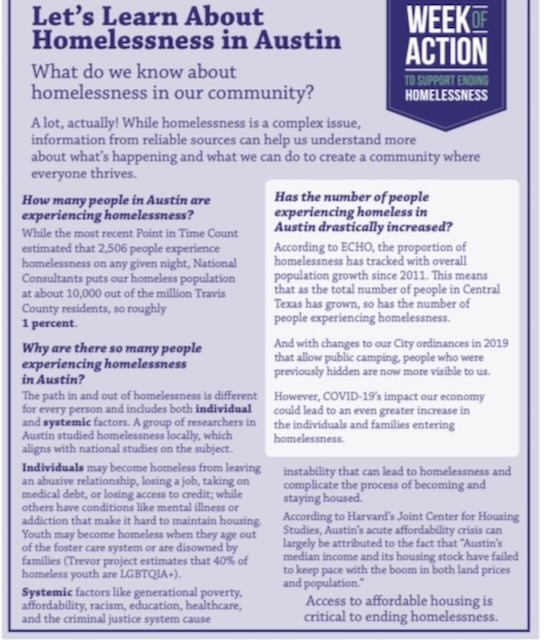
2020 City of Austin Flyer on Homelessness – The 10,000 homeless population number is near the top of the left hand column
But, it’s not not totally clear what made up the 10,350. An ECHO representative is quoted in the KXAN article saying the 10,000 number is “very misleading” and “not based in fact.” He explains that the number was made up of people “accessing one of many services.”
But the consultant report itself says that the figure included:
- “(those) served by street outreach programs,
- (in) emergency shelter,
- and transitional housing,
- as well as an estimate of annualized unsheltered persons who were not enrolled in street outreach.”
This appears to be very close, if not identical, to the components ECHO uses in its “snapshot.” As already reported above, in their 2024 “snapshot” ECHO defines “unsheltered” as people “sleeping in tents, cars, abandoned buildings, and other places not meant to live in.” And, they define “sheltered” as “staying in emergency shelters or transitional housing.”
The people that should be able to clear this up would be the City’s HSO Department, like maybe a spokesperson. The Department spokesperson, however, ignored our questions which asked:
- if this consultants’ number was determined to be wrong,
- if so why, and
- what the City believes was the actual number at the time.
We will explore this further going forward, but for now let’s summarize the differing figures we have discussed so far.
Summarizing the Numbers
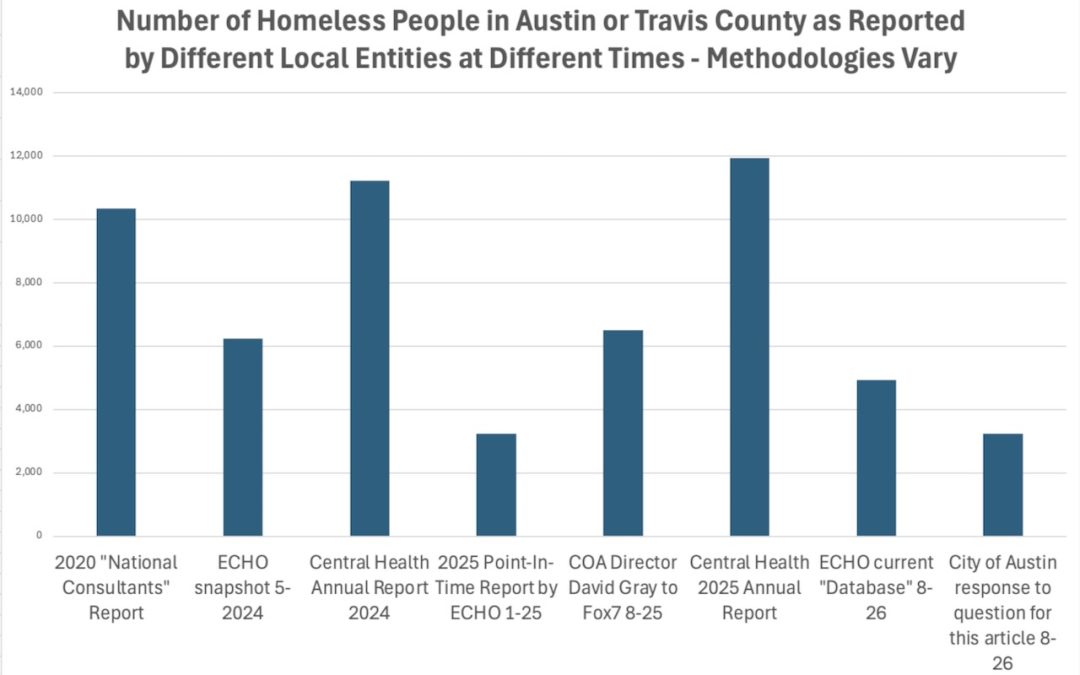
- 2025 (most recent) Point in Time count, the number to which the City Homeless Strategies and Operations Department referred us to when asked for their estimate of the current number of people experiencing homelessness: 3,238.
- ECHO 2024 “snapshot” of a single day: 6,235.
- Number of “unsheltered” homeless cited by HSO Director David Gray, as reported by Fox7 in August 2025: 6,500.
- 2024 Central Health figure of “people experiencing homelessness (who) were enrolled in Central Health coverage plans, including MAP (Medical Access Program), MAP Basic, and CHAP (Central Health Assistance Program).” 11,225.
- 2025 Corresponding figure from Central Health. 11,932.
- ECHO number of homeless sheltered and unsheltered currently appearing on their website “Database,” 4,935.
- 2020 “National Consultant” Report, later disputed and called incorrect by ECHO: 10,350.
(The above numbers are all compared in the graph at the very top.)
Given all these varying numbers, one question we asked David Gray, in writing, was “Do you think the wide range of numbers damages public confidence in the City’s efforts to house and administer to people experiencing homelessness?”
A Department spokesperson replied:
“Dynamically and longitudinally communicating the complexity of both the population experiencing homelessness as well as articulating the intricacies of system response to meet these complexities is difficult and convoluted. Homelessness Response Systems nationally and locally have challenges to distill these multiple indicators of demand and progress to constituents. The City is committed to continuing efforts to increase transparency in investment outcomes as well as communicating the accomplishments of our partners. Public confidence grows when they can see fewer of their fellow neighbors experiencing the trauma of homelessness.”
“Dynamically and longitudinally communicating the complexity of both the population experiencing homelessness as well as articulating the intricacies of system response to meet these complexities is difficult and convoluted. . .
Austin homeless strategies and operations spokesperson
Well, that should restore any lost confidence.
To me, the clearest part of that paragraph was the last sentence. It says that seeing less homeless people on the street will be what increases public confidence. That may well be true, but – to me – it appears that there is an ever increasing number of homeless people on the streets of Austin, not fewer. Everyone has to make their own determination on that, and as to whether it increases their confidence in the City government and the HSO.
Regardless, this is no way to determine an actual number for the population the City of Austin is committed to serving. And this comes after the City has spent a whole lot of taxpayer money pursuing their goal to “end homelessness” in Austin. I did a rough count as I was finishing this article and quickly came up with more than half a billion dollars spent since 2019.
Yet homeless population numbers are all over the place. Among other things, it seems like the City would be eager to work with other governmental or public service entities, like Central Health, who keep figures on the number of homeless people in Travis County — instead of just dismissing Central Health’s number as different “definitions, timing, methodologies, and geographic focus.” Maybe the good government approach would be to reach out to Central Health and see if anything can be learned from them, to try and work together to establish a more solid number. Just a thought.
Note to Readers: In an attempt to learn more about this range of figures and to zero in on a reliable estimate, we sent six questions to HSO Director David Gray. We asked for replies in writing, explaining, “I have been researching homelessness services through the City and ECHO websites, and in the media, for quite some time. I now have some questions that I would appreciate if you can answer in writing. Because these initial questions have to do with numbers, I would like to get the answers in writing rather than in an interview. If you want to do an interview later I would be happy to do that.”
The Department answered but — as already noted — asked that I describe the answers as coming from a “spokesperson,” which can be read as meaning Gray is not responsible for the answers. We will post the full set of questions and answers, along with some analysis in a future edition, or editions.
The spokesperson also began the City’s answers by telling me “Please reach out to ECHO for clarification on their methodology and the criteria utilized for the calculation of figures.” They also advised me to “Please consult with ECHO” when I asked about Gray’s claim of 3,000 people being housed during 2024.
I asked the City because they are the ones ultimately responsible. And, Director David Gray has repeatedly cited figures from ECHO, which the City funds. So I continue to believe that the City department responsible for dealing with homelessness issues should be able to answer such questions; and even more importantly should have a much better handle on how many people are experiencing homelessness in Austin.
The HSO spokesperson, however, insisted that I talk to an ECHO representative before they answered my questions. So I did, to someone who was pulled off vacation for the discussion. That person and I had a very friendly conversation, but he was not familiar with the Central Health number and thus could not give me definitive, on the record, answers.
On the other hand I am willing to discuss numbers with ECHO, but the City did not make this request until they had had my questions almost a week, and on the morning of the deadline I had given them to provide answers.
The day after the City sent their answers, I sent the same list of questions to ECHO and asked for replies in writing, at least to the questions where the HSO spokesperson said “consult ECHO.” It was not a realistic timeframe for them to respond for this article, but I will return to this topic in future installments, including with more of the Q and A with HSO. There is a lot more to discuss.
___________________________________
Folks: Local journalism costs money to produce and you will be hard pressed to find the kind of local journalism the Austin Independent provides anywhere else. Also, the Austin Independent has revamped its Donate page and with a new vendor. So if you have had trouble subscribing before please click Donate now and give the new system a try. Even if you haven’t had trouble before why not celebrate with us and subscribe and/or make a donation. Thank you.
The Austin Independent, a publication of The Austin Independent, LLC
All Rights Reserved