

Austin is a place filled with liberal minded and very compassionate people. Among other examples, this is reflected in the “Austin Action Plan to End Homelessness” which the City Council passed in 2023. But, as is obvious to anyone who travels the streets of Austin, we are a long way from ending homelessness here. Meanwhile the City of Austin has spent more than half a billion dollars since 2019 on efforts to combat homelessness; and that does not account for significant expenditures from departments not included in the above total. As we watch the city budget burgeoning each year, we need to ask why are the number of homeless people continuing to rise instead of going down?
As we saw in Part 1 of our series on homelessness issues, the City cannot even settle on a number of how many people they think are homeless in Austin, publicly stating numbers that range from 3,238 to more than 6,500. At the same time City officials dismiss a much higher number, 11,392, provided by Central Health — even though the Central Health number is based on hard data; that being the number of individual people who sought treatment through the agency’s programs and, in signing up, reported that they were homeless.
In this article, Part 2 of our series, we will focus on another number that is repeatedly emphasized by both the City’s Homeless Strategies and Operations Department (HSO) and their top nonprofit contractor ECHO. For example, ECHO reports that during the 2025 Point-In-Time (PIT) survey 68% of people interviewed said they “became homeless in Austin/Travis County.” City officials frequently cite this figure as well. That is usually followed by the assertion that Austin’s homelessness problem stems from a lack of affordable housing, which is doubtlessly true in some cases, but certainly not all cases. Typical is what HSO Director David Gray told the media in May 2025, as quoted by Fox7 News: “Over two-thirds of people experiencing homelessness first experienced homelessness in Central Texas, and so really, it’s a lot of local economic factors that are driving people into homelessness.”
Gray’s statement illustrates what information the City likes to highlight as well as issues they shy away from discussing. Specifically, in the statements cited above neither he nor ECHO provide any information about the 32% who became homeless somewhere else and then moved to Austin; and after extensive research I am not aware that they ever have. Plus, the focus on “local economic factors” helps avoid mention of mental illness and drug addiction as causes of homelessness— two conditions that often overlap in the same person.
What About the 32% Who Came From Somewhere Else?
It can’t be known for sure what is intended in presenting the statistics this way, but framing the issue in this manner appears to intentionally diminish the importance, and the presence, of the 32% who first became homeless somewhere else and for some reason decided to move to Austin. That is a sizable number, even using the City’s figures. (We asked HSO: “Does ECHO or the City ask how long people have been in Austin or Travis County?” A HSO spokesperson said no.)
As to the actual number of people in the 32%, David Gray said back in August 2025 that “on any given night, we have 6,500 people experiencing unsheltered homelessness.” Note that Gray said the 6,500 number was “unsheltered” homeless people and did not mention people housed in shelters.
ECHO’s January 2025 Point In Time (PIT) count reported 1,661 sheltered homeless people. The sheltered count is considered more accurate than ECHO’s count of “unsheltered” people experiencing homelessness because sheltered people are easier to find and count. Combining those two numbers gives us a count of 8,161 people. (ECHO’s PIT Count is a biannual federally required event in which volunteers fan out throughout Travis County trying to locate homeless people and interview them.)
Applying the unmentioned 32% to the 8,161 number yields 2,611 people who first became homeless somewhere else and then, at some point, moved to Austin. That’s a significant number of people who came to town and are living on the streets.
Of course it is even higher if we use Central Health’s 2025 data-driven number of 11,392 individual homeless people — people who signed up with Central Health medical programs.
Thirty-two percent of that is 3,645 people experiencing homelessness in Austin who did not become homeless here. That is a very notable number of people.
Economic conditions, yes, but what about mental health and addiction?
Now let’s return to our original quote from David Gray and examine the other part of the situation that his framing omits or discounts. After citing the figure regarding 68% of homeless people in Austin saying they first experienced homelessness here, Gray added, “so really, it’s a lot of local economic factors that are driving people into homelessness.”
As already noted, there is really little, if any, doubt that “local economic factors” drive at least some people into homelessness — or are at the very least a major contributing factor — although Gray offers no examples or data. Also Gray doesn’t suggest that any national economic problems are to blame — like say the distribution of wealth skewing to the very top at Gilded Age proportions.
Even more astounding given the situation in Austin, by mentioning only “local economic factors” Gray entirely avoids bringing up two other, related, factors contributing to homelessness: serious mental health problems and addiction to hard drugs — as already noted, two conditions that often overlap in the same person. Citizens can readily see examples of both while moving around town. In fact citizens often have to be careful to avoid people who are experiencing potentially violent mental health episodes.
ECHO, does at times mention mental health. For instance an August 2024 report from ECHO said that 44.8% of Austin’s homeless population have mental health “conditions.” But, they only describe people developing mental health problems while homeless — not as a cause of or contributor to homelessness.
For instance they write, “People’s physical and mental health are often negatively impacted by the harsh conditions and daily trauma of living on the streets. Over half of people served by our HRS report one or more disabling conditions. The most common conditions people face are health-related, including mental health (44.8%), chronic health (29.7%) and physical health (27.8%) conditions.”
ECHO also lists both “mental health illness” and “substance use” as “disabilities.” It is almost certain that being homeless would affect someone’s mental health, but there are also people who are homeless because of mental health problems, often with simultaneous drug addiction. It’s sort of amazing that a nonprofit receiving millions in public funds to deal with homelessness would talk around this issue and avoid mentioning mental health as a cause of homelessness.
So Many Questions
This all raises a number of challenging and potentially unpleasant questions that many will not want to discuss; evidently including the City’s top officials on homelessness. Some might even be offended, or outraged, that such questions are broached. But, the view here is that a problem cannot be adequately addressed without being willing to discuss all elements of the situation, examining the root causes and using accurate numbers.
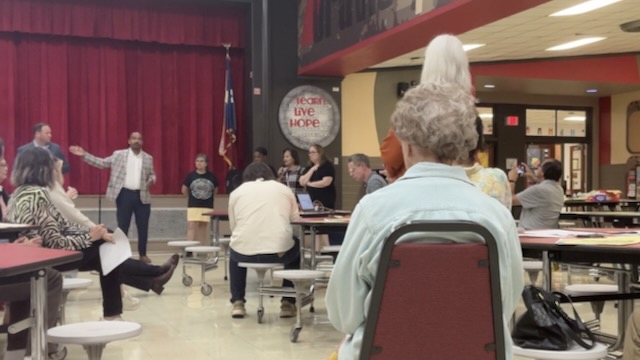
David Gray speaking to South Austin residents at a Travis High meeting about a homeless services center approved nearby, January 2026. Screenshot from video by Daryl Slusher. Photo of City Hall at the top by Adela Mancías.
Following are just a few questions.
Why are so many homeless people moving to Austin? Weather is likely one reason, but there have to be more.
Is this indeed a high number or does the same thing happen in other cities? If so, which cities and how do their homelessness policies and programs compare to ours?
Is the generosity and open nature of our policies attracting more homeless people to move here? I realize some may find this question harsh, but once again I think solving serious problems requires a sometimes brutally frank examination of the problem. Then policies can be devised with as complete knowledge of the issue as possible.
Could factors driving homeless people to move here also include our lax enforcement of the camping ban, our lenient policies on camping in our parks and greenbelts, allowing panhandling at every traffic intersection, and a District Attorney, County Attorney and judicial system predisposed to release homeless people who commit crimes, up until they commit a very violent crime?
Looking at potential outside contributing factors, are law enforcement officials in surrounding cities still driving homeless people to Austin and dropping them off, as was done with the young mentally disturbed man in 2016 who then killed the young UT dancing student Haruka Weiser— who came to Austin from Beaverton, Oregon to attend UT only to be murdered under the Waller Creek bridge?
Also, is there any truth to fairly widespread claims by some publilc officials, and others, that the state of Texas is disproportionately releasing felons with violent histories from prison or halfway houses onto the streets of Austin, even if the people are not from Austin?
Finally, does avoiding mentioning mental health issues as a cause of homelessness, and ignoring the large number of homeless people moving to Austin, in some way contribute to helping Austin “end homelessness?”
One Employee Breaks Free of the Narrative
Someone breaking away from the narrative, even for one social media post, can yield quite a different picture than given by the talking points of HSO Director David Gray. That’s how I would describe a September 26, 2025 social media post from City Intergovernmental Officer Carrie Rogers. At the time Rogers was fairly new in town from Dallas. She posted the following on LinkedIn.
“Since the Texas legislative sessions ended, my full time gig+ has been focusing on local issues. Top of the list: homelessness and mental health. I had a standing meeting for two hours behind Council chamber — in the lobby, you might say — with our City of Austin Chief Homeless Strategies Director, Housing Director and Permitting Director, and various additional leaders rotating in and out of the intense discussion.
Persons experiencing homelessness and needing mental health intervention have the most costly and highest barriers to housing. And guess what? People from all over the state arrive here in Austin for those services by a number of means. This past weekend, we met with someone on our streets who came here from City of Green Bay. Today, it was someone from the City of Los Angeles.
Mental health resources have not scaled with the need.
This is where we will be focusing our attention. More to come.”
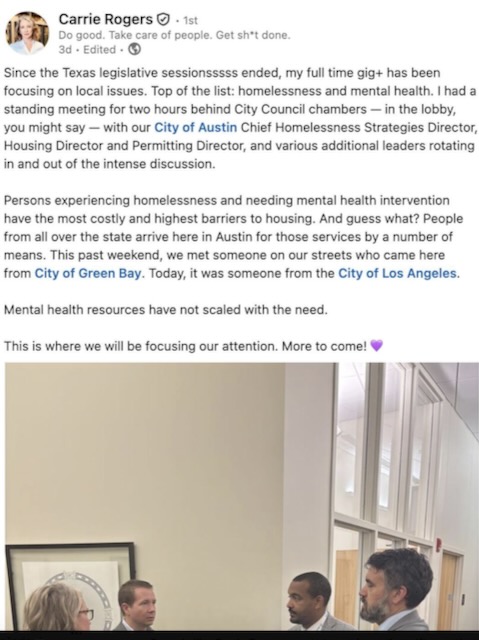
Homeless Strategies and Operations Director David Gray is in the center
This kind of candor and excitement is refreshing, as is Rogers’ willingness to engage homeless people on the street. She is also right about a shortage of “mental health resources;” which as she accurately puts it, “have not scaled with the need.”
Also, in stark contrast to the HSO she provides a glimpse at the scale of the 32% of the homeless who moved here after becoming homeless: “People from all over the state” and also, as she had just experienced, from Los Angeles and Green Bay — a pretty vast geographical span there.
If the Homeless Strategies and Operations Department was as open with information as Rogers, then discussions about homelessness would be much better informed and more real questions could be addressed. Rogers, however, does not work in the HSO. She was focusing on the issue in the lull between legislative sessions — a lull which will end soon.
Nonetheless Rogers has clearly been busy since her social media post almost a year ago. She was the author of an August 3 memo announcing a new approach specifically for “High utilizers,” who in this context, are “defined as people who generate disproportionate demand and are indexed in the top 1% of number of arrests, behavioral health call-outs, substance use-related incidents, or Criminal Trespass Notices.” Rogers continued, “This clearly defined population is causing excessive system costs and resource use across multiple response systems, while also risking their health and safety by living in perpetual crisis without dedicated care.”
Citing the “Meadows Mental Health Policy Institute (MMHPI),” Rogers wrote that “there are at least 950 people in Travis County who are at this intersection of the local emergency response system.” She added, “This high-utilizer population has a significant financial impact across the local criminal justice, homelessness, and health care capacity. The cost is estimated to be $144,000 per person, or a total cost of $137 million annually.”
“This high-utilizer population has a significant financial impact across the local criminal justice, homelessness, and health care capacity. The cost is estimated to be $144,000 per person, or a total cost of $137 million annually.”
Memo from Carrie Rogers, City of Austin City Intergovernmental Officer
Rogers writes that “the City Manager’s Office (to which she reports directly) established” the new program, called “No Wrong Door (NWD).” The core idea is to coordinate responses to the “high utilizers,” to hopefully save money, improve overall response, and hopefully help the “high utilizers.” Rogers continues that “while new initiatives take time to grow roots,” there is already a Memorandum of Understanding between “17 local and regional agencies and organizations,” including: “Within the City of Austin, Austin Homeless Strategies & Operations (HSO), Austin Police (APD), Austin-Travis County Emergency Medical Services (EMS), Austin Fire (AF), and Austin Community Court (CC), along with external emergency response partners, including Ending Community Homelessness Coalition (ECHO), Travis County District Attorney, Travis County Attorney, Central Health, Downtown Austin Alliance, Integral Care, Ascension Texas, Baylor Scott & White, CapMetro, and The Sobering Center.”
We’ll see how this works out, but, for now, it’s at least a foray into some new ground and might even address some unanswered questions..
_____________________
Folks: The Austin Independent is free to everyone who wants to read it, but it still takes money to publish and to research. Please consider subscribing or donating on our revamped Donate page. Local journalism costs money to produce and you will be hard pressed to find the kind of local journalism the Austin Independent provides anywhere else. Thank you.
The Austin Independent, a publication of The Austin Independent, LLC
All Rights Reserved